Memodyne Official Website › Benefits
BenefitsWhat the Memodyne label claims, and what stands behind each claim
Five claims, all of them support claims, and none of them approved by anybody.
They are structure/function statements, which is the category a supplement is allowed to make without pre-approval. They set the ceiling for everything this shop says, and this page prints them next to what the published record supports.
The seller's own five statements, printed verbatim, each set against what the published record actually shows.
The five Memodyne support claims, verbatim
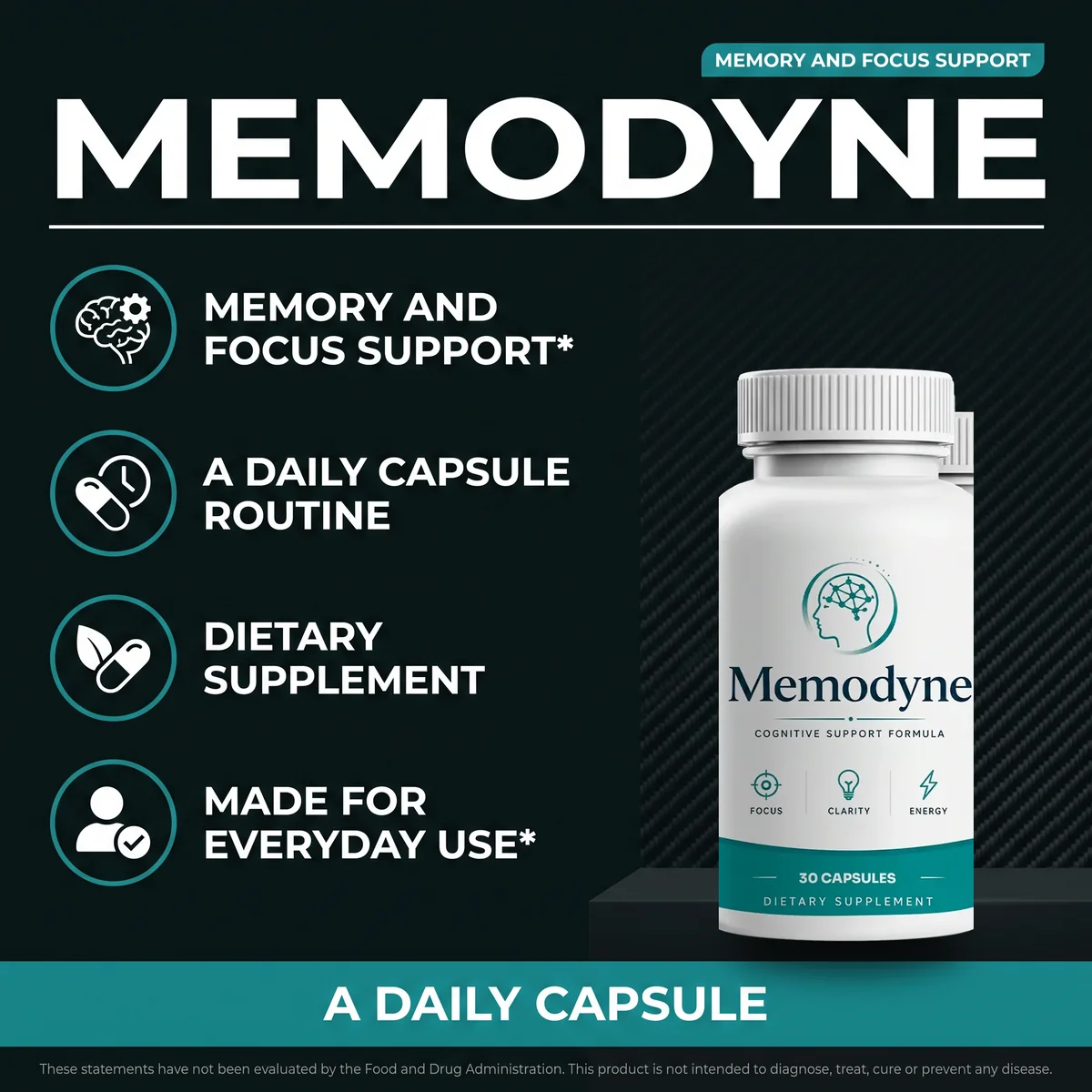
The distributor's own card is more careful than the sales page it sits beside. It says memory and focus support, with an asterisk, and made for everyday use, with another. Both asterisks point at the standard disclaimer along the foot of the card.
That is the correct way to word a supplement claim, and it is worth noticing that the artwork does it and the landing page is looser.
| What the seller says it supports | What stands behind it |
|---|---|
| Enhance memory function and support overall cognitive health | No trial of this product or this combination exists. The claim rests on the ingredient names rather than on a result. |
| Protect the brain from oxidative stress and improve mental clarity | Nothing on this artwork is an antioxidant in the usual sense. This is the loosest of the five. |
| Boost neural communication and promote better brain performance | The closest of the five to a measurement. Blood flow is what the citrulline work studies, and one trial measured it in the brain. |
| Support long-term brain health and improve focus and concentration | Long-term is doing a lot of work here. The longest randomised look at any ingredient on this label is five years of calcium, which found nothing either way. |
| Optimize neurotransmitter production and contribute to a sharper, more agile mind | Niacin becomes NAD, which is upstream of a great deal of metabolism. Neurotransmitter production specifically is an inference rather than a finding. |
Claims read from the seller's page on 20 September 2026. These statements have not been evaluated by the Food and Drug Administration.
Read across, the pattern is consistent: the claims are plausible extensions of what the named ingredients do in other contexts, and none of them has been tested in this capsule. That is the ordinary state of affairs for a supplement and it is stated here rather than implied.
What Memodyne does not claim, and cannot
- It is not a treatment for memory loss, dementia or Alzheimer's disease, and nothing on this website should be read as suggesting otherwise.
- It is not a substitute for any prescribed medicine.
- It does not claim to reverse anything. Every one of the five statements is a support claim.
- It carries no clinical trial of its own, and the seller does not claim one.
- It is not FDA-approved, because dietary supplements are not approved by the FDA. The FDA's own questions and answers explain the difference.
What a buyer can reasonably expect from Memodyne
A routine, reliably
One capsule with a glass of water each morning is a habit most people can keep. That is worth something on its own, and it is the thing the product delivers with certainty.
A vascular ingredient set with real literature
The citrulline work is genuine and the blood-pressure findings in middle-aged and older adults are meta-analysed. Whether a capsule reaches those amounts is the open question, not whether the ingredient does anything.
A refund route if nothing changes
60 days from purchase, a telephone order desk and a named returns address. That is a clearer exit than most of this category offers.
No stimulant, and no crash
Nothing here jolts and nothing here wears off. For a product taken every morning indefinitely, that is the right design.
What a buyer should not expect is a difference in the first week, or a difference large enough to be obvious without having written anything down. The distributor's own reviewer roster reports nothing before day twenty-six.
What “support” means on a Memodyne label
The word carries a specific legal weight and most buyers read straight past it. A dietary supplement in the United States may describe an effect on the structure or a function of the body — supports memory, supports circulation, supports bone health — without pre-approval, provided the statement is truthful, is not misleading, and is accompanied by the disclaimer that appears at the foot of every page on this website.
What it may not do is claim to diagnose, treat, cure or prevent a disease. The moment a product says it treats memory loss, or slows dementia, it is making a drug claim and the rules change entirely.
| Wording | What it is | Allowed without approval? |
|---|---|---|
| “Supports memory function” | A structure/function claim | Yes, with the disclaimer |
| “Improves mental clarity” | A structure/function claim, worded more strongly | Yes, with the disclaimer, and it is the kind of wording that attracts attention |
| “Treats age-related memory loss” | A disease claim | No. That is a drug claim |
| “Prevents dementia” | A disease claim | No, and nothing on this artwork comes near it |
The FDA's own questions and answers on dietary supplements set out the distinction.
All five of the seller's statements sit in the first category. None of them names a disease and none of them uses a treatment verb. That is the ceiling this shop writes under, and it is why every page here describes what the ingredients do in other contexts rather than what Memodyne does to a person.
How the Memodyne claim set compares with the rest of the shelf
| Claim style | Typical of | Where Memodyne sits |
|---|---|---|
| Five support statements, no disease named, disclaimer present | A compliant mainstream supplement | This is the set on offer here |
| A named clinical trial of the finished product | A small minority of supplements, usually the expensive ones | Not claimed, and the seller does not pretend otherwise |
| A printed Supplement Facts panel with amounts | Almost every supplement sold in a shop | Absent from the supplied artwork, which is this label's weakest point |
| A disease claim | Products that attract regulatory letters | Nothing of the kind appears on the artwork or the sales page |
A comparison of claim styles rather than of brands.
Two of those four rows are in this product's favour and one is firmly against it. The missing panel is the fault, and it is the fault a reader should weigh hardest, because it is the one that stops any of the other rows being checked.
Memodyne claims: common questions
What does Memodyne claim to do?
Five things, all worded as support rather than as treatment: memory function and cognitive health, protection from oxidative stress and mental clarity, neural communication and brain performance, long-term brain health with focus and concentration, and neurotransmitter production.
Are those claims approved by anyone?
No. They are structure/function statements, which a supplement may make without pre-approval provided it does not claim to treat a disease. They have not been evaluated by the FDA and they carry the standard disclaimer wherever they appear.
Does Memodyne claim to treat dementia?
It does not, and it could not lawfully. Nothing on the artwork or the seller's page names a disease, and nothing on this website does either.
Which claim is closest to the evidence?
The vascular half of the third one. Blood flow is where the citrulline literature actually lives, and it is the only claim on the list with a cerebrovascular measurement anywhere behind it.
Who publishes this Memodyne website?
- Li A, Li H, Chen J. The effects of L-citrulline supplementation on cerebrovascular function during sprint interval training in taekwondo athletes. J Exerc Sci Fit. 2025;23(3):222-228. PMID 40474881. https://pubmed.ncbi.nlm.nih.gov/40474881/
- Luo P, Chen J, Liu K, Zhang J. Does l-citrulline supplementation and watermelon intake reduce blood pressure in middle-aged and older adults? A systematic review and meta-analysis of randomized controlled trials. Clin Nutr ESPEN. 2025;69:653-664. PMID 40789388. https://pubmed.ncbi.nlm.nih.gov/40789388/
- Ghasemifard N, Lewis JR, Radavelli-Bagatini S, et al. Calcium supplementation and the risk of dementia in the Perth Longitudinal Study of Aging Women: a post-hoc analysis of a randomised clinical trial for fracture prevention. Lancet Reg Health West Pac. 2025;63:101694. PMID 41346785. https://pubmed.ncbi.nlm.nih.gov/41346785/
- Morris MC, Evans DA, Bienias JL, et al. Dietary niacin and the risk of incident Alzheimer's disease and of cognitive decline. J Neurol Neurosurg Psychiatry. 2004;75(8):1093-9. PMID 15258207. https://pubmed.ncbi.nlm.nih.gov/15258207/
- Yeung LK, Alschuler DM, Wall M, et al. Multivitamin Supplementation Improves Memory in Older Adults: A Randomized Clinical Trial. Am J Clin Nutr. 2023;118(1):273-282. PMID 37244291. https://pubmed.ncbi.nlm.nih.gov/37244291/
- Questions and Answers on Dietary Supplements. U.S. Food and Drug Administration. https://www.fda.gov/food/information-consumers-using-dietary-supplements/questions-and-answers-dietary-supplements
- Using Dietary Supplements Wisely. National Center for Complementary and Integrative Health, National Institutes of Health. https://www.nccih.nih.gov/health/using-dietary-supplements-wisely
Order Memodyne on what it actually claims
Five support statements, none of them approved by anybody, each printed here beside what the published record shows. That is the honest basis for the purchase.
Two bottles $158 · six bottles $294 · 60 days from purchase
Order Memodyne From This ShopLot MEM-26/ME-6233 · 30 capsules, one each morning · dispatched from within the United States