Memodyne Official Website › Memodyne Ingredients
Memodyne IngredientsMemodyne ingredients: the six names, and the one in dispute
Six names, no amounts, and a disagreement about the sixth.
The artwork prints niacin, calcium as calcium carbonate, L-arginine, L-arginine AKG 2:1 extract, L-citrulline HCl and L-citrulline malate. It carries no Supplement Facts panel, so no quantity is published for any of them. The seller's own ingredient section names beta-alanine in the calcium slot; this page follows the container.
Every name the artwork prints, what each one is, what the published trials behind it used, and the one place the container and the sales page do not agree.
What the Memodyne artwork actually prints
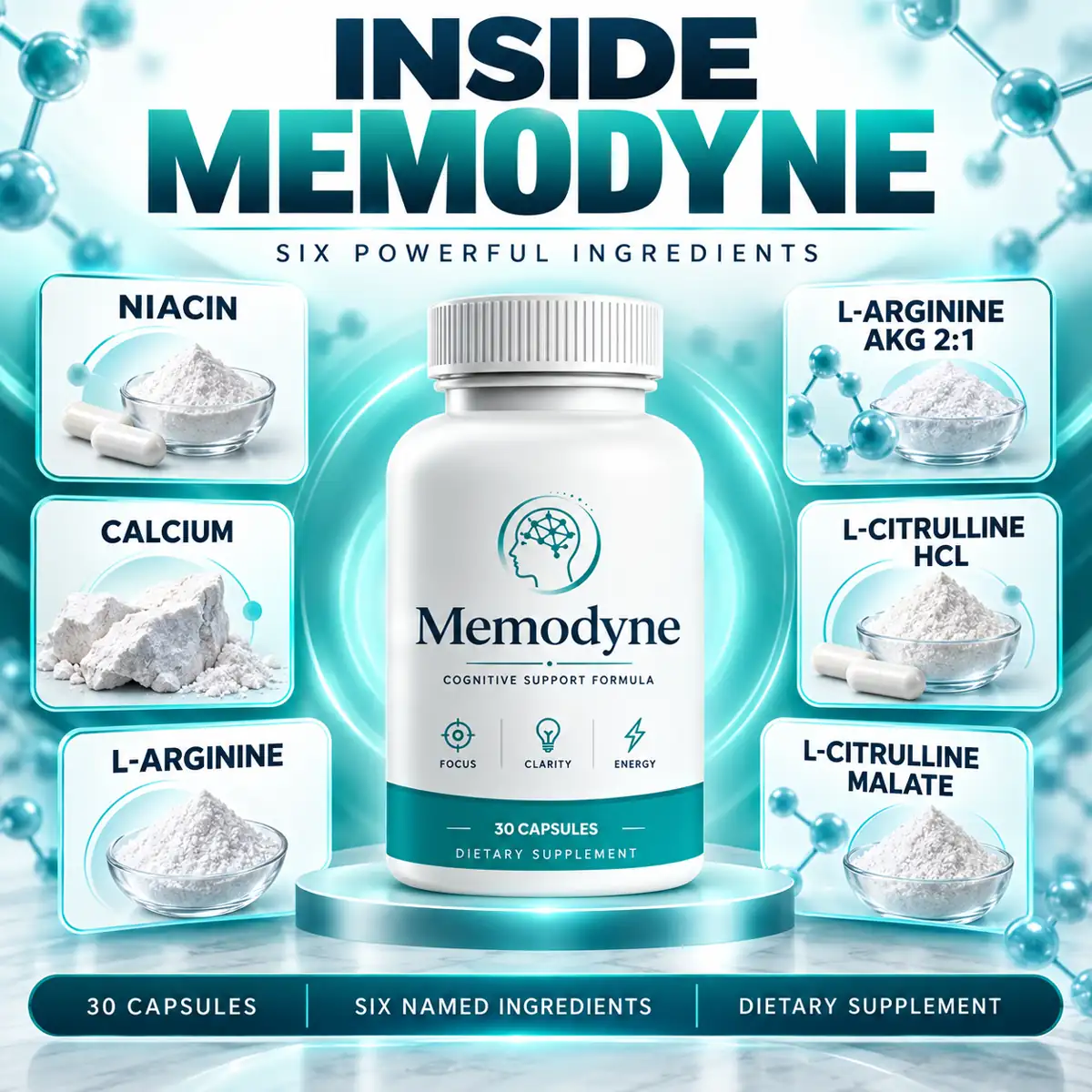
The distributor's ingredient card is headed Inside Memodyne with the subtitle six powerful ingredients. Six tiles ring the bottle, three on each side, each with a name and a photograph of a white powder. A strip across the foot repeats the count.
Reading it left to right and top to bottom: niacin, calcium, L-arginine on the left; L-arginine AKG 2:1, L-citrulline HCl, L-citrulline malate on the right. Not one tile carries a figure.
Ingredient lists on a printed panel are conventionally ordered by weight, largest first. This is not a printed panel, so the order here carries no such guarantee — it is simply the order the distributor's own graphic uses, reproduced rather than rearranged.
The six Memodyne ingredients, one at a time
What it is, where it has been studied, and the amount that study used.
Niacin (Vitamin B3)
vitaminNo amount printedA B vitamin the body converts into NAD and NADP, the two coenzymes that carry electrons through energy metabolism. Every cell needs it, brain cells included, and severe deficiency produces pellagra, whose third classical symptom is dementia.
What the research used: Dietary intakes in the low tens of milligrams a day. Who it was studied in: an observational cohort, not a trial. The record read for this page is the Chicago Health and Aging Project analysis.
Calcium (as Calcium Carbonate)
mineral saltNo amount printedChalk, chemically speaking, and the cheapest and densest form of supplemental calcium. It needs stomach acid to dissolve, which is why the form and the timing on this particular label are worth reading together.
What the research used: 1,200 mg a day for five years in the randomised dementia analysis. Who it was studied in: bone density first, cognition as a follow-up question. The record read for this page is the Perth calcium and dementia analysis.
L-Arginine
amino acidNo amount printedA conditionally essential amino acid and the direct substrate for nitric oxide, the signalling molecule that relaxes the muscle in a blood-vessel wall. Swallowed on its own, a large share never reaches the bloodstream intact.
What the research used: A single labelled meal in the kinetic work; supplement trials run in grams. Who it was studied in: blood pressure and exercise, not memory. The record read for this page is a stable-isotope study of dietary arginine.
L-Arginine AKG 2:1 Extract
amino acid saltNo amount printedArginine bound to alpha-ketoglutarate at two parts to one. It is a pre-workout ingredient sold on the idea that the salt survives digestion better than plain arginine does.
What the research used: 4 g three times a day, 12 g daily, for eight weeks in the PK trial. Who it was studied in: resistance training, not memory. The record read for this page is the arginine AKG pharmacokinetic trial.
L-Citrulline HCL
amino acid saltNo amount printedCitrulline sidesteps the gut and liver losses that catch arginine, and the kidney converts it back into arginine. That is why it raises plasma arginine more reliably than arginine itself does.
What the research used: 8.8 g a day for five days in the cerebrovascular trial. Who it was studied in: cerebral blood flow during hard exercise. The record read for this page is the citrulline cerebrovascular trial.
L-Citrulline Malate
amino acid saltNo amount printedThe same citrulline bound to malic acid, which is the pairing the sports literature uses most often and the one most powders are built from.
What the research used: 8 g a day for three days; 3 g a day for six weeks in older women. Who it was studied in: sprinting, resistance training and lower-limb function. The record read for this page is a three-day citrulline malate trial.
The sixth Memodyne ingredient: calcium carbonate or beta-alanine?
Not a quibble about spelling. Two unrelated substances, two different bodies of evidence.
Two documents describe this formula and they do not agree about its sixth ingredient.
| Source | Sixth ingredient named | Where it appears |
|---|---|---|
| The bottle artwork | Calcium (as Calcium Carbonate) | The Inside Memodyne ingredient card, bottom-left tile |
| The distributor's named list | Calcium (as Calcium Carbonate) | Second entry in the six-item list supplied with the product |
| The seller's web page | Beta-Alanine | Its ingredient section, and again in its FAQ answer on how the formula works |
Read on 20 September 2026.
This shop prints the artwork. The reasoning is short: printed artwork is the statement that travels on the container a buyer receives, it is the version the distributor's own pack repeats, and a landing page is advertising that can be edited in an afternoon.
It matters more than a naming quibble, because the two are not related substances and they bring different evidence with them.
If it is calcium carbonate
- Calcium carbonate is a mineral salt. Its cognitive evidence is a post-hoc analysis of a randomised trial: 1,460 Australian women aged seventy and over, randomised to 1,200 mg a day of calcium carbonate or placebo for five years and followed for another nine and a half.
- The finding was a null one in both directions. No increase in dementia events, and no reduction either.
- Its safety literature is well developed. A 2023 meta-analysis of twelve randomised trials found no association between calcium supplementation and heart attack, stroke, heart-failure admission or mortality.
- Its absorption depends on stomach acid, which is why the timing on this label is worth a second look.
If it is beta-alanine
- Beta-alanine is an amino acid and the rate-limiting half of carnosine.
- Its cognitive evidence is a ten-week imaging trial at 2.4 g a day in adults aged sixty to eighty. Twenty were randomised; ten met the cognitive-score criterion and were analysed.
- The finding was a change in fractional anisotropy in the hippocampus and amygdala — a structural imaging measure, not a memory test score.
- Its one reliable side effect is paraesthesia, a harmless skin tingling, which is dose-dependent and would be noticeable at gram amounts.
Ring the order desk on +1 (302) 200-3480 and ask whoever answers to read the ingredient panel off a physical bottle. It takes a minute and it settles the question for your own purchase, which is more than this page can do. It matters particularly if you already take a calcium supplement, if you have been told to limit calcium, or if you have had the tingling reaction to beta-alanine from a pre-workout powder before.
What the Memodyne label does not publish
This section and the sixth-name section above are where this page is blunt. The rest of it describes the product.
The left column is empty on every row because the artwork leaves it empty. The right column is what the published work used, and the gap between them is not small: from 3 g a day at the bottom to 12 g a day at the top, of one ingredient at a time.
Niacin is the exception and it is worth knowing why. Its useful amount is measured in milligrams rather than grams, so it is the one name here that could plausibly be present at a studied level in a capsule. The 2017 upper-intake review puts the tolerable upper intake at 35 mg a day, set on flushing rather than on harm, and the HPS2-THRIVE trial used 2 g a day of extended-release niacin, which is a pharmaceutical dose and nowhere near anything a daily capsule would carry.
What is not in Memodyne
- No botanical extract. No ginkgo, no bacopa, no huperzine.
- No stimulant named anywhere on the artwork.
- Nothing resembling the unapproved drug ingredients found in some cognitive-enhancement supplements in 2022.
- No proprietary blend label, because there is no panel to print one on.
- No gelatin, if the vegetarian emblem and the seller's hypromellose answer are both accurate.
Absences are worth printing when the category is full of the thing being absent. Three of the five above are genuine points in this label's favour.
Memodyne ingredient questions
How many ingredients are in Memodyne?
Six, by the count the artwork itself prints along the foot of the ingredient card: thirty capsules, six named ingredients, dietary supplement.
Does Memodyne list milligrams anywhere?
No. The supplied artwork carries no Supplement Facts panel, so there is no serving size, no milligram figure and no percent Daily Value for any of the six. The order desk can read the panel off a physical bottle over the telephone.
Which ingredient does the sales page get wrong?
The sixth. The bottle artwork and the distributor's named list both print calcium as calcium carbonate; the seller's ingredient section and its FAQ print beta-alanine. This page prints the artwork and shows both.
Is there caffeine in Memodyne?
Nothing on the artwork names caffeine or any other stimulant. The band on the front prints the word energy, which in this formula refers to niacin's role in cellular metabolism rather than to a stimulant effect.
What is the capsule shell made of?
Hypromellose, a plant cellulose, according to the seller's own FAQ. That is also what the vegetarian emblem on the pack is a claim about.
Who publishes this Memodyne website?
- Morris MC, Evans DA, Bienias JL, et al. Dietary niacin and the risk of incident Alzheimer's disease and of cognitive decline. J Neurol Neurosurg Psychiatry. 2004;75(8):1093-9. PMID 15258207. https://pubmed.ncbi.nlm.nih.gov/15258207/
- Minto C, Vecchio MG, Lamprecht M, Gregori D. Definition of a tolerable upper intake level of niacin: a systematic review and meta-analysis of the dose-dependent effects of nicotinamide and nicotinic acid supplementation. Nutr Rev. 2017;75(6):471-490. PMID 28541582. https://pubmed.ncbi.nlm.nih.gov/28541582/
- HPS2-THRIVE Collaborative Group; Landray MJ, Haynes R, Hopewell JC, et al. Effects of extended-release niacin with laropiprant in high-risk patients. N Engl J Med. 2014;371(3):203-12. PMID 25014686. https://pubmed.ncbi.nlm.nih.gov/25014686/
- Recker RR. Calcium absorption and achlorhydria. N Engl J Med. 1985;313(2):70-3. PMID 4000241. https://pubmed.ncbi.nlm.nih.gov/4000241/
- Ghasemifard N, Lewis JR, Radavelli-Bagatini S, et al. Calcium supplementation and the risk of dementia in the Perth Longitudinal Study of Aging Women: a post-hoc analysis of a randomised clinical trial for fracture prevention. Lancet Reg Health West Pac. 2025;63:101694. PMID 41346785. https://pubmed.ncbi.nlm.nih.gov/41346785/
- Sim MG, Teo YN, Teo YH, et al. Association Between Calcium Supplementation and the Risk of Cardiovascular Disease and Stroke: A Systematic Review and Meta-Analysis. Heart Lung Circ. 2023;32(10):1230-1239. PMID 37743221. https://pubmed.ncbi.nlm.nih.gov/37743221/
- Mariotti F, Petzke KJ, Bonnet D, et al. Kinetics of the utilization of dietary arginine for nitric oxide and urea synthesis: insight into the arginine-nitric oxide metabolic system in humans. Am J Clin Nutr. 2013;97(5):972-9. PMID 23535108. https://pubmed.ncbi.nlm.nih.gov/23535108/
- Morita M, Hayashi T, Ochiai M, et al. Oral supplementation with a combination of L-citrulline and L-arginine rapidly increases plasma L-arginine concentration and enhances NO bioavailability. Biochem Biophys Res Commun. 2014;454(1):53-7. PMID 25445598. https://pubmed.ncbi.nlm.nih.gov/25445598/
- Campbell B, Roberts M, Kerksick C, et al. Pharmacokinetics, safety, and effects on exercise performance of L-arginine alpha-ketoglutarate in trained adult men. Nutrition. 2006;22(9):872-81. PMID 16928472. https://pubmed.ncbi.nlm.nih.gov/16928472/
- Li A, Li H, Chen J. The effects of L-citrulline supplementation on cerebrovascular function during sprint interval training in taekwondo athletes. J Exerc Sci Fit. 2025;23(3):222-228. PMID 40474881. https://pubmed.ncbi.nlm.nih.gov/40474881/
- Rougé C, Des Robert C, Robins A, et al. Manipulation of citrulline availability in humans. Am J Physiol Gastrointest Liver Physiol. 2007;293(5):G1061-7. PMID 17901164. https://pubmed.ncbi.nlm.nih.gov/17901164/
- Faria VS, Egan B. Effects of 3 days of citrulline malate supplementation on short-duration repeated sprint running performance in male team sport athletes. Eur J Sport Sci. 2024;24(6):758-765. PMID 38874989. https://pubmed.ncbi.nlm.nih.gov/38874989/
- Ramos-Hernández R, Pascual-Fernández J, Álvarez-Pardo S, et al. Short-term citrulline malate supplementation enhances lower-limb function in physically active older women: A pilot randomized controlled trial. Clin Nutr ESPEN. 2026;74:103356. PMID 42162613. https://pubmed.ncbi.nlm.nih.gov/42162613/
- Ostfeld I, Zamir A, Ben-Zeev T, et al. β-Alanine supplementation improves fractional anisotropy scores in the hippocampus and amygdala in 60-80-year-old men and women. Exp Gerontol. 2024;194:112513. PMID 38971131. https://pubmed.ncbi.nlm.nih.gov/38971131/
- Cohen PA, Avula B, Khan I. The unapproved drug centrophenoxine (meclofenoxate) in cognitive enhancement dietary supplements. Clin Toxicol (Phila). 2022;60(10):1156-1158. PMID 35959800. https://pubmed.ncbi.nlm.nih.gov/35959800/
Order Memodyne with the six names in front of you
Six ingredients on the artwork, no published amounts, and one name the seller's own page states differently. Everything this shop knows about the formula is on this page, and the order desk can read the panel off a bottle if you want the figure.
Two bottles $158 · six bottles $294 · 60 days from purchase
Order Memodyne From This ShopLot MEM-26/ME-6233 · 30 capsules, one each morning · dispatched from within the United States