Memodyne Official Website › Journal › Method
MethodBuy Memodyne online when the label shows no amounts
Memodyne publishes no amounts, so the usual method — find the panel, compare the figures against the trials — cannot be started. Six steps that do not need a figure, a way to run the purchase as an experiment, and four situations where the answer is no.
The position a buyer is actually in
A supplement with no published amounts puts a reader in an unusual spot. The ordinary method — find the panel, look up the three largest figures, compare them against the trials — cannot be started, let alone finished.
That is the position with this product, and with a good number of others sold the same way. The question this piece is about is what a careful buyer does next, given that refusing to buy anything without a panel is one answer and not the only one.
This is a dietary supplement, and nothing on this page is medical advice. Where forgetfulness has become the kind other people remark on, the useful next step is an appointment rather than an order; MedlinePlus sets out what is worth raising at one.
What a nameplate label does still tell you
More than it first appears. Names are not nothing, and several useful things can be settled without a single figure.
- Which category the product belongs to. Four amino acid names put this one in the nitric-oxide group rather than among the botanicals, which decides what literature is even relevant.
- Whether anything on it is a problem. A list containing nothing that resembles an unapproved drug ingredient is a list that has cleared the category's worst failure mode.
- Which prescriptions it might touch. Four nitric-oxide names is a clear signal to anyone on a nitrate, a PDE5 inhibitor or a blood-pressure medicine, and that conversation does not need a milligram figure to be worth having.
- What scale of dose is possible. A capsule is a capsule. The format caps the amounts whether or not they are printed.
- What the seller is claiming. Five support statements and no disease claim is a compliant claim set, and it is checkable in thirty seconds.
None of that answers will it work. All of it answers is this a sensible thing for me to try, which is the question most buyers are actually asking.
A method for buying without numbers
Six steps, in order, none of which needs a figure the label does not supply.
- Read what the container says and what the sales page says, side by side. On this product they differ about the sixth ingredient, which is the kind of thing that only surfaces when the two are compared.
- Find the category. Look up one representative trial for the dominant ingredient group. Half an hour tells you whether the category has produced anything at all.
- Check the failure modes. Unapproved drug ingredients, botanicals with large null trials, claims that name a disease. Three searches.
- Check the interactions against your own medicine list. This is the step that matters most and the one most often skipped.
- Read the refund terms properly. Length, what it is counted from, who pays return postage, whether a minimum use period applies. In a category sold by direct response this is most of what you are buying.
- Then treat the purchase as an experiment with an end date. One measure chosen in advance, one line a week, and a decision inside the window.
Order Memodyne from the official U.S. shop
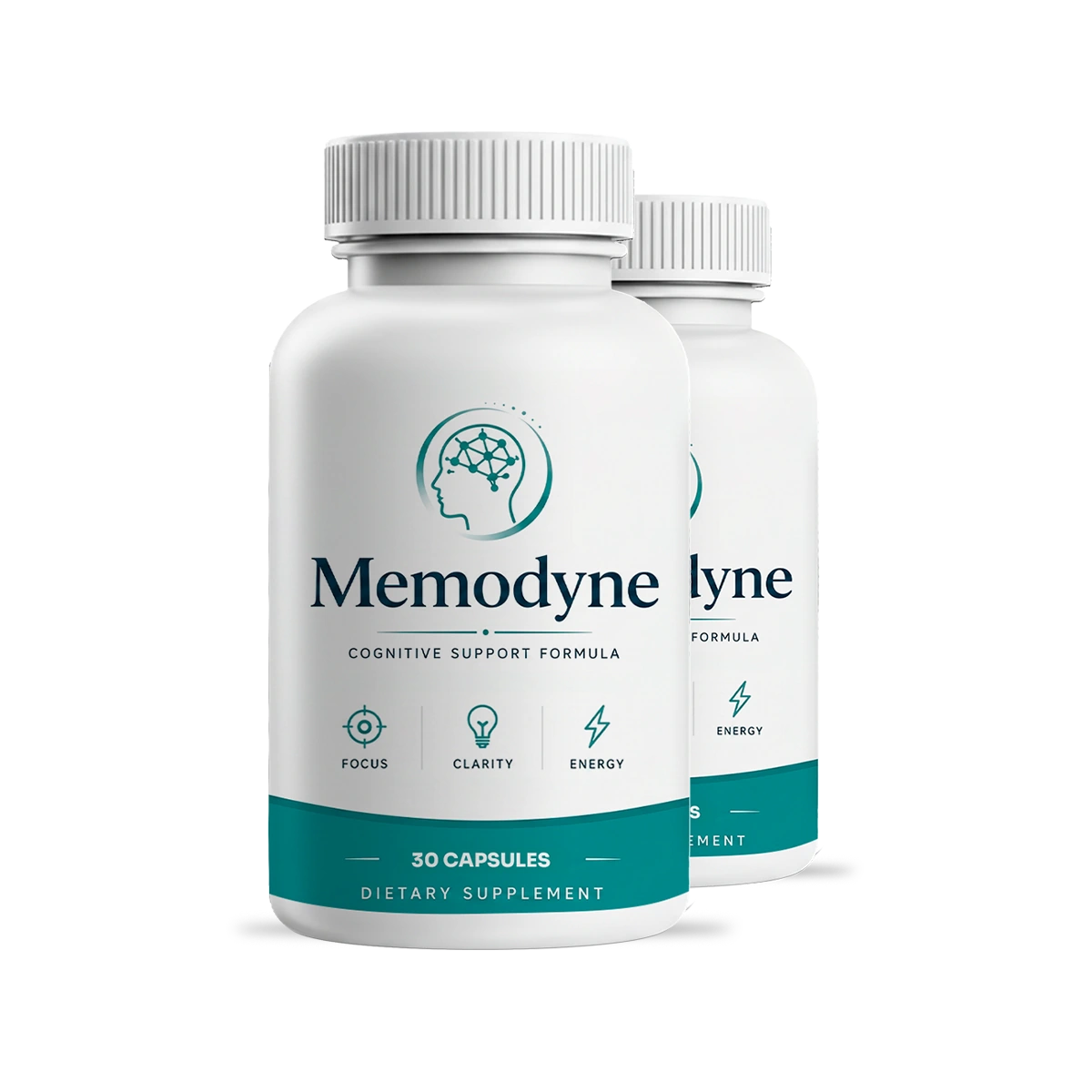
One capsule a day, thirty to a bottle, six names on the artwork and no amounts beside them. Two bottles, three or six, each paid for once, with sixty days from the date of purchase to change your mind.
Two bottles $158 · six bottles $294 · 60 days from purchase
Order Memodyne From This ShopLot MEM-26/ME-6233 · 30 capsules, one each morning · dispatched from within the United States
Running it as an experiment
The last step is the one that turns an unverifiable purchase into a useful one, and it is worth more detail than it usually gets.
Choose the measure before the first capsule
One countable thing. How often a word goes missing mid-sentence. Whether the back half of a long meeting is harder than the front. How many times a week the keys need a search. Chosen on day one, not on day twenty-nine, because a measure chosen at the end is a measure chosen to fit the answer.
Change one thing at a time
A new capsule, a new sleep routine and a new coffee habit in the same month produce one outcome and no way to attribute it. This matters here more than usual, because two of the three packs arrive with five downloads, one of which is about sleep — and sleep has randomised evidence for memory consolidation that no ingredient on this label can match.
Write it down and read it back
Four lines over a month. At day thirty, read them before asking yourself the question, because the answer given without reading them is mostly a memory of how hopeful you felt when you ordered.
Decide inside the window
60 days from the date of purchase on this product, with 30 days of use asked for first, which puts the decision in the second month. Diarise it the day the parcel arrives.
Four mistakes people make when the numbers are missing
Each of these fills the gap with something that feels like information and is not. All four are easier to make than to notice.
Treating an ingredient name as inheriting its trial
A product containing citrulline is not a product shown to do what 8.8 g of citrulline did in twenty athletes. The name is the same and nothing else is. This is the commonest error in the category and a great deal of marketing depends on it.
Reading a review score as evidence about a formula
A star score describes the expectations of the minority of buyers who wrote something down. It is a decent source about service and a useless one about pharmacology, and no number of reviews converts one into the other.
Taking a wall of emblems as testing
Most marks in this category are statements about a facility or about sourcing. Nine of them together are five assurances about a supply chain and none about the contents of a capsule.
Assuming a long list means a strong product
Capsule volume is fixed, so a longer list is a more thinly divided one. On this label four of the six names are entrances to a single pathway, which makes the count less informative still rather than more.
When the honest answer is not to buy
A method for buying without numbers should include the cases where the method returns no.
| Situation | Why a supplement is the wrong move |
|---|---|
| Memory has changed enough for other people to notice | That is a reason for an assessment. MedlinePlus sets out what is worth reporting, and six months on a capsule instead is six months |
| You are on a nitrate, a PDE5 inhibitor or blood-pressure medicine | Four of these six names act on the same end point. That is a prescriber's conversation, before anything is bought |
| The budget is tight and something has to give | A daily multivitamin has better randomised memory evidence in older adults than anything on this label and costs a fraction of it |
| You want certainty about what you are taking | This product does not publish amounts. A product that does is a better purchase for you, whatever else is true about either |
Four cases where this desk would rather a reader did something else. Printing them is cheaper than a refund and considerably cheaper than a reader who feels misled.
What a label that solves this looks like
It is worth describing the alternative concretely, because "publish a panel" is vague and the useful version is not.
| What a good label in this category prints | Why it matters to a buyer |
|---|---|
| A Supplement Facts panel with a serving size and an amount for every ingredient | It is the only thing that makes two products comparable at all |
| A percent Daily Value where one exists | It converts a milligram figure into something a reader can place |
| An other ingredients line naming the shell and the fillers | It answers the vegetarian, gluten and allergen questions without an email |
| Related ingredients grouped so their total is visible | Four entrances to one pathway should be judged as one number |
| A lot-specific certificate of analysis, published rather than referenced | A reference names a document; the document is the assurance |
None of the five is expensive. Four of them already exist somewhere in a manufacturer's files.
A product that printed all five would be straightforward to evaluate and would win or lose on the numbers. That is a commercial risk, and it is the real reason nameplate labels persist in this category.
- A panel is legally ordinary furniture on a supplement container, not a concession.
- Its absence from supplied artwork is a marketing decision rather than a manufacturing one.
- A seller willing to read the panel over the telephone has most of the way there; publishing the photograph would finish the job.
- Until it does, a buyer is choosing between the names on offer and the amounts somebody else publishes.
What buying on names is, honestly
It is a bet with a known structure. The mechanism is real, the ingredient choice within it is sensible, the format caps the dose, and the amounts are unpublished. The upside is a cheap daily habit that might do something; the downside is capped at the price of a pack and the cost of return postage.
Stated that plainly, plenty of people will take it and plenty will not, and both are reasonable. What is not reasonable is taking it while believing the arithmetic has been checked, because on this product it cannot be.
The label's own gap is set out on ingredients; the terms of the bet are on guarantee and pricing.
- Cohen PA, Avula B, Khan I. The unapproved drug centrophenoxine (meclofenoxate) in cognitive enhancement dietary supplements. Clin Toxicol (Phila). 2022;60(10):1156-1158. PMID 35959800. https://pubmed.ncbi.nlm.nih.gov/35959800/
- Yeung LK, Alschuler DM, Wall M, et al. Multivitamin Supplementation Improves Memory in Older Adults: A Randomized Clinical Trial. Am J Clin Nutr. 2023;118(1):273-282. PMID 37244291. https://pubmed.ncbi.nlm.nih.gov/37244291/
- Yasser E, Ayache L, El Khayat H, et al. Sleep and memory consolidation: Neural and cognitive perspectives. Prog Brain Res. 2026;299:137-176. PMID 42547206. https://pubmed.ncbi.nlm.nih.gov/42547206/
- Memory. MedlinePlus, U.S. National Library of Medicine. https://medlineplus.gov/memory.html
- Using Dietary Supplements Wisely. National Center for Complementary and Integrative Health, National Institutes of Health. https://www.nccih.nih.gov/health/using-dietary-supplements-wisely
- Questions and Answers on Dietary Supplements. U.S. Food and Drug Administration. https://www.fda.gov/food/information-consumers-using-dietary-supplements/questions-and-answers-dietary-supplements