Memodyne Official Website › Journal › Labels
LabelsMemodyne ingredients: the six names on the label
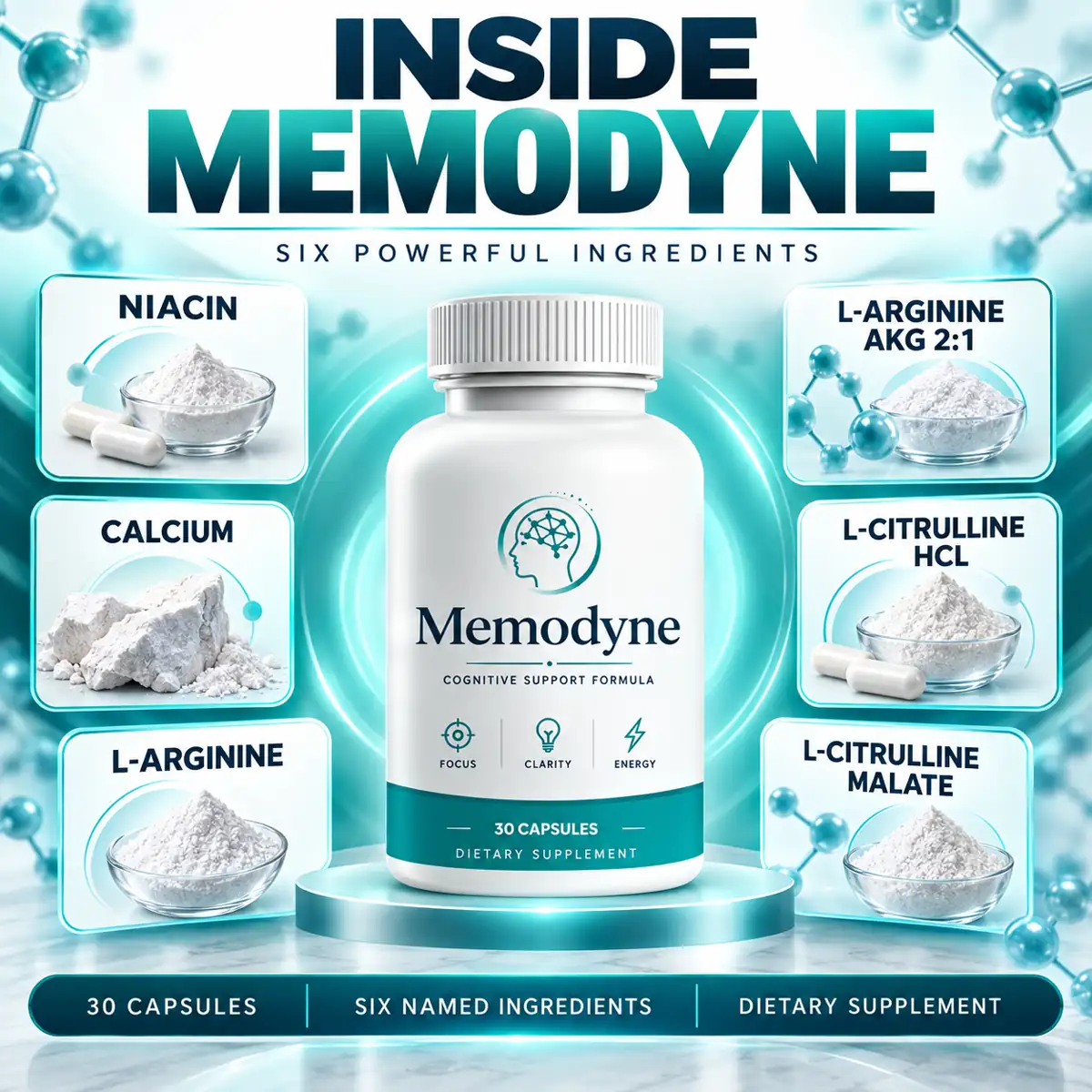
The Memodyne ingredients list on the bottle artwork names six ingredients: niacin, calcium as calcium carbonate, L-arginine, L-arginine AKG 2:1, L-citrulline HCl and L-citrulline malate. No amount is printed beside any of them. The seller's own ingredient section and its FAQ name beta-alanine in place of calcium. They are unrelated substances with different evidence behind them, and this desk follows the container rather than the advertisement.
Two documents, one bottle
Every direct-response supplement comes with at least two descriptions of itself. There is the container, which carries printed artwork and whatever regulated panel the manufacturer has put on it, and there is the web page selling it, which is written by somebody else at a different time for a different purpose.
Usually they agree, in the loose way that a photograph and a caption agree. On this product they do not, and the disagreement is about an ingredient.
This is a dietary supplement, and nothing on this page is medical advice. Where forgetfulness has become the kind other people remark on, the useful next step is an appointment rather than an order; MedlinePlus sets out what is worth raising at one.
What each document says
Two sources come with this product and both name six ingredients. Five of the six are identical across them. The sixth is not.
| Source | Sixth name | Where exactly |
|---|---|---|
| The bottle artwork | Calcium (as Calcium Carbonate) | The Inside Memodyne ingredient card, which rings the bottle with six named tiles and prints a count along the foot |
| The distributor's supplied ingredient list | Calcium (as Calcium Carbonate) | Second entry in the six-item list that arrives with the product |
| The seller's web page, ingredient section | Beta-Alanine | Described as an amino acid that raises carnosine levels in the brain |
| The seller's web page, FAQ | Beta-Alanine | Named again in the answer about how the formula works, as the ingredient that protects neurons against oxidative stress |
Read on 20 September 2026. The other five names match exactly across all four.
These are not two spellings of one thing, and they are not a generic name and a branded one. Calcium carbonate is a mineral salt; beta-alanine is an amino acid. They do different things, they are measured on different scales, and they carry entirely different research.
Which one this desk follows, and why
The artwork, every time, and the reasoning is short enough to state in a sentence: printed artwork is the statement that travels on the container the buyer receives.
There are three supporting reasons and they are worth spelling out, because this is a judgement rather than a rule handed down from anywhere.
- It is the document in the buyer's hand. A landing page can be edited in an afternoon and frequently is. A print run of labels cannot.
- Two pack sources agree and one page does not. The artwork and the supplied ingredient list say the same thing; the outlier is the advertising.
- Advertising drifts in a predictable direction. Where a marketing description and a container differ, the marketing description is usually the one that has been improved.
It is not evidence that anything has been substituted in the bottle, and it is not a safety warning. The likeliest explanation by far is that one of the two documents was updated and the other was not, which happens constantly in this category. What it is, is a reason to treat the sales page as advertising and the container as the document.
Why the difference changes the argument for the product
If the two ingredients did similar jobs, this would be pedantry. They do not, and the evidence that would support the product is different in each case.
| Calcium carbonate | Beta-alanine | |
|---|---|---|
| What it is | A mineral salt, the cheapest and densest supplemental form of calcium | An amino acid, the rate-limiting half of carnosine |
| Cognitive evidence | A post-hoc analysis of a randomised trial: 1,460 Australian women aged 70 and over on 1,200 mg a day of calcium carbonate or placebo for five years, followed 14.5 years | A ten-week imaging trial at 2.4 g a day in adults aged 60 to 80; twenty randomised, ten analysed |
| What it found | No difference in dementia events in either direction | A change in fractional anisotropy in the hippocampus and amygdala — a structural imaging measure rather than a memory score |
| Study size | Large | Very small |
| Known side effect | Constipation at supplemental amounts | Paraesthesia, a harmless skin tingling, at gram doses |
| Affected by the label's timing instruction | Yes, considerably | No |
Two unrelated substances, two literatures of very different sizes, and two different answers to what a buyer is paying for.
A reader deciding on the strength of the science needs to know which row applies. A reader who already takes calcium, or who has had the tingling reaction to beta-alanine from a pre-workout powder, needs to know it more urgently still.
Order Memodyne from the official U.S. shop
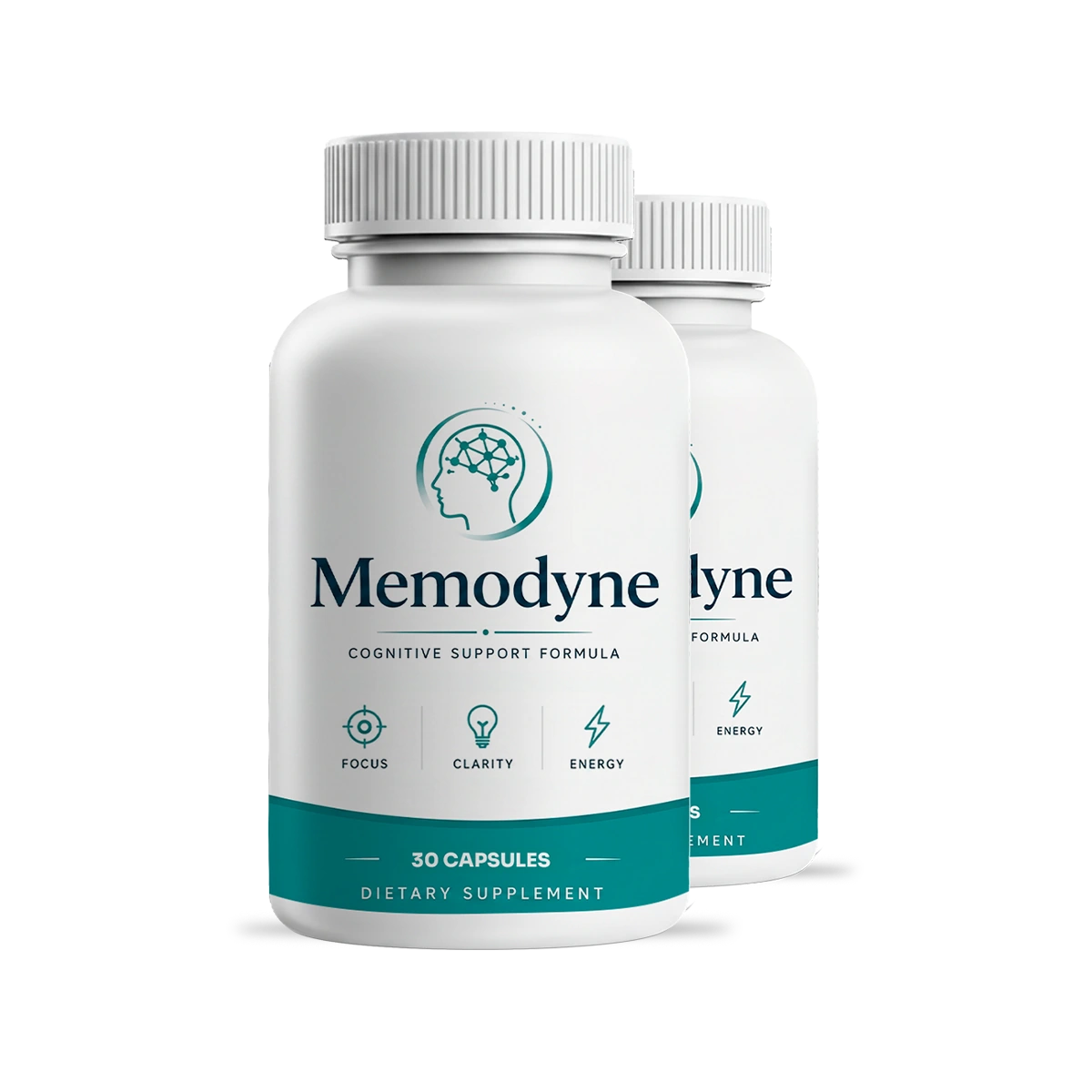
One capsule a day, thirty to a bottle, six names on the artwork and no amounts beside them. Two bottles, three or six, each paid for once, with sixty days from the date of purchase to change your mind.
Two bottles $158 · six bottles $294 · 60 days from purchase
Order Memodyne From This ShopLot MEM-26/ME-6233 · 30 capsules, one each morning · dispatched from within the United States
How to settle it for your own purchase
This can be resolved in about a minute and it does not require anybody to trust either document.
- Ring the order desk on +1 (302) 200-3480.
- Ask whoever answers to read the ingredient panel off a physical bottle.
- Ask specifically whether calcium or beta-alanine appears, since a general question invites a general answer.
- Write down what you are told, with the date.
- If the answer contradicts the artwork, the artwork is what this shop prints and a correction to the editors will get this website changed.
It is worth doing before ordering rather than after. A bottle that has been opened is a harder conversation than a question asked in advance, and the 60-day window is running the whole time either way.
What this says about the category
Disagreements of this kind are not rare and they are not usually sinister. They are a symptom of how these products are assembled: a manufacturer makes a formula, a label is printed, a marketing page is written from a brief, and the two documents then age at different rates.
The lesson generalises past this bottle. When a supplement's sales page and its container disagree about anything — an ingredient, a count, a dose, a guarantee — the container is the document, and a seller who cannot reconcile the two on request is telling you something about how carefully the rest of the page was written.
- Compare the container photograph on a sales page against the ingredient list written beneath it. They are meant to match.
- Count the names in both. A count printed on artwork is a useful check.
- Where a product ships no panel photograph at all, treat the ingredient list as an advertisement rather than as a specification.
- Ask. A seller that will read a panel over the telephone is a seller worth buying from; one that will not is telling you something too.
How often this happens across the shelf
It is worth knowing that this is a class of problem rather than a one-off, because the fix generalises. A supplement typically has four descriptions of itself in circulation and they are written by different people at different times.
| Description | Written by | How often it changes | How much weight to give it |
|---|---|---|---|
| The printed panel on the container | The manufacturer, under labelling rules | Only when a formula changes and a new print run is ordered | The most, by a distance |
| The marketing artwork supplied with the product | The manufacturer's design side | Per campaign, and it usually tracks the panel | A great deal, and it is what this product ships instead of a panel |
| The sales page's ingredient section | A copywriter, from a brief | Whenever the page is optimised, which can be weekly | Treat as advertising |
| A marketplace listing | Whoever runs the listing | Unpredictably, and often copied from an older version of the page | Least of all |
Four documents, one product. When two of them disagree, the order above is the order to trust them in.
On this product the top two agree and the third is the outlier, which is the most common shape this takes. The reverse — artwork that disagrees with its own printed panel — would be a more serious matter and is not what is happening here.
The rest of the label, briefly
Nothing above should crowd out what is not in dispute. Five of the six names are agreed by every source: niacin, L-arginine, L-arginine AKG 2:1, L-citrulline HCl and L-citrulline malate. Four of those five feed nitric oxide production, which is a real mechanism with real literature behind it, and how it works follows that chain step by step.
What none of the sources publishes is an amount, for any of the six. That is a separate problem and it is the subject of another piece in this journal. The two problems compound: a reader cannot check the quantities, and on one ingredient cannot be certain of the identity either.
- Ghasemifard N, Lewis JR, Radavelli-Bagatini S, et al. Calcium supplementation and the risk of dementia in the Perth Longitudinal Study of Aging Women: a post-hoc analysis of a randomised clinical trial for fracture prevention. Lancet Reg Health West Pac. 2025;63:101694. PMID 41346785. https://pubmed.ncbi.nlm.nih.gov/41346785/
- Sim MG, Teo YN, Teo YH, et al. Association Between Calcium Supplementation and the Risk of Cardiovascular Disease and Stroke: A Systematic Review and Meta-Analysis. Heart Lung Circ. 2023;32(10):1230-1239. PMID 37743221. https://pubmed.ncbi.nlm.nih.gov/37743221/
- Ostfeld I, Zamir A, Ben-Zeev T, et al. β-Alanine supplementation improves fractional anisotropy scores in the hippocampus and amygdala in 60-80-year-old men and women. Exp Gerontol. 2024;194:112513. PMID 38971131. https://pubmed.ncbi.nlm.nih.gov/38971131/
- Questions and Answers on Dietary Supplements. U.S. Food and Drug Administration. https://www.fda.gov/food/information-consumers-using-dietary-supplements/questions-and-answers-dietary-supplements
- Memory. MedlinePlus, U.S. National Library of Medicine. https://medlineplus.gov/memory.html
Memodyne ingredients list: frequently asked questions
What are the Memodyne ingredients?
The artwork names six: niacin, calcium as calcium carbonate, L-arginine, L-arginine AKG 2:1, L-citrulline HCl and L-citrulline malate.
How much of each Memodyne ingredient is in a capsule?
No amount is printed. The supplied artwork carries no Supplement Facts panel, so this shop does not estimate one.
Why does the seller's page list beta-alanine?
The seller's ingredient section and FAQ name beta-alanine where the artwork names calcium. This shop follows the bottle artwork.
How can I check the Memodyne ingredients list myself?
Ring the order desk on +1 (302) 200-3480 and ask them to read the panel off a physical bottle, naming calcium and beta-alanine.