Memodyne Official Website › Journal › Doses
DosesHow much is in a Memodyne capsule? Size of a 30-capsule bottle
A hard capsule holds well under a gram of powder, split between however many ingredients are in it. The trials behind Memodyne's amino acid names used 3 g to 12 g a day of a single ingredient. Niacin is the one name on this label whose studied amount fits.
A question with an arithmetic answer
Supplement marketing operates almost entirely in names. A formula is described by what is in it, rarely by how much, and a reader is invited to add up the names and feel reassured.
There is a physical constraint underneath all of it that is worth understanding once, because it applies to every capsule on every shelf and it does not depend on trusting anybody.
This is a dietary supplement, and nothing on this page is medical advice. Where forgetfulness has become the kind other people remark on, the useful next step is an appointment rather than an order; MedlinePlus sets out what is worth raising at one.
What a capsule physically holds
Hard capsules come in standard sizes. The common ones in this category are size 0 and size 00, and they hold a volume rather than a weight — the weight depends on how dense the powder inside is.
As a rough working figure, a size 0 capsule holds in the region of half a gram of a typical powder and a size 00 holds rather more. Denser powders pack more in; light, fluffy botanical extracts pack less.
| Capsule | Approximate fill | What that is, in context |
|---|---|---|
| Size 0 | In the region of 0.4–0.5 g of typical powder | About a fifth of a level teaspoon |
| Size 00 | In the region of 0.7–0.9 g | Still under a gram |
| A six-ingredient split, size 00 | Under 0.2 g each if divided evenly | Though nothing requires an even division, and it is rarely even |
Approximate figures for orientation. Actual fill depends on the density of the specific powder, and none of it is published for this product.
Nothing about that is controversial. It is why a multivitamin is a tablet rather than a capsule, why protein comes in a tub, and why a product built around amino acids at gram doses is normally a powder.
What the trials behind these names used
Set the capsule constraint beside the amounts that produced the published results and the picture arranges itself.
| Ingredient | A published trial | The amount it used |
|---|---|---|
| L-Citrulline HCl | cerebrovascular function during sprint intervals | 8.8 g a day for five days |
| L-Arginine AKG | pharmacokinetics and performance | 4 g three times a day, 12 g daily, for eight weeks |
| L-Citrulline Malate | a moderate versus high dose comparison | 8 g and 12 g, acutely |
| L-Citrulline Malate | lower-limb function in older women | 3 g a day for six weeks, alongside exercise |
| Calcium carbonate | the Perth dementia analysis | 1,200 mg a day for five years |
| Niacin | the tolerable upper intake review | The upper limit is 35 mg a day |
Every figure here was read out of the paper's own abstract. The one on the last row is the only one that fits comfortably alongside five other ingredients.
Three grams is the smallest amino-acid figure in that table and it is still several times what a capsule holds in total. Eight point eight grams is roughly ten to twenty capsules' entire contents.
That comparison is not specific to this product and it is not an accusation about it. It applies to every capsule in this category that names amino acids, and it is the reason the pre-workout aisle sells powder in tubs.
Order Memodyne from the official U.S. shop
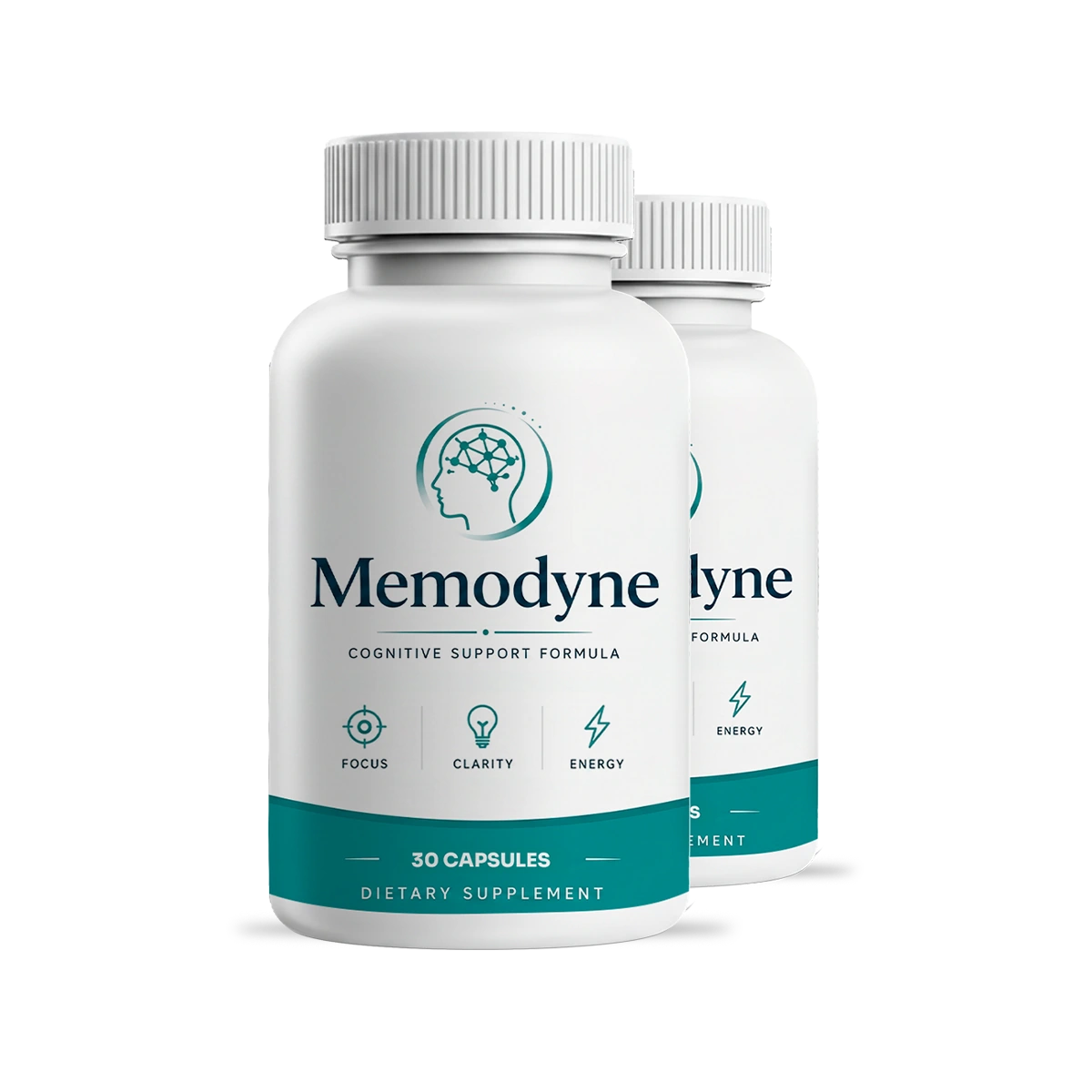
One capsule a day, thirty to a bottle, six names on the artwork and no amounts beside them. Two bottles, three or six, each paid for once, with sixty days from the date of purchase to change your mind.
Two bottles $158 · six bottles $294 · 60 days from purchase
Order Memodyne From This ShopLot MEM-26/ME-6233 · 30 capsules, one each morning · dispatched from within the United States
The one ingredient where the arithmetic works
Niacin is the exception and it is worth understanding why, because it illustrates the general rule.
Vitamins are active in milligrams and micrograms. Amino acids used as supplements are active in grams. That is a thousandfold difference in scale, and it is why a capsule can hold a useful amount of one and not of the other.
The 2017 upper-intake review sets the US tolerable upper intake level at 35 mg a day, based on flushing rather than on harm. Whatever amount this capsule carries, it is bounded by what a responsible manufacturer will put in a daily product, and a figure in that range is entirely plausible.
On a label that publishes no amounts, the vitamin is the one name a reader can reason about at all. Everything else on the list has a studied dose that does not fit, so the only honest statement about it is that the amount is unknown.
What actually follows from this
Two conclusions, and the second is less obvious than the first.
- A capsule form is a strong signal about amounts. Before reading a single review, the format tells a reader roughly what scale of dose is possible. A capsule of amino acids is a small dose of amino acids by construction.
- This does not make the product worthless. A small amount of something is not nothing, effects are not all-or-nothing, and nobody has established a threshold below which citrulline does nothing at all. What it does mean is that the published trials cannot be used to predict what this capsule will do, because they were not run at anything like this scale.
The second point is the one that gets lost in both directions. Enthusiasts treat a named ingredient as inheriting its trial's result; critics treat a small dose as a guarantee of nothing. Neither follows. What follows is that the question is open and the label does not help to close it.
Why this product is a capsule at all
If the format caps the dose, the obvious question is why anybody sells amino acids in capsules. There are four answers and none of them is dishonest.
- Compliance. People take capsules. A tub of powder that has to be measured, mixed and drunk gets abandoned far faster than something swallowed with a glass of water in four seconds.
- Taste. Citrulline malate is sour and arginine is unpleasant. A capsule hides both, and a product nobody can face at seven in the morning is a product nobody takes.
- Cost of goods. Grams are expensive. A capsule product sold at $49 to $79 a bottle would cost considerably more if it carried trial doses of four amino acids for thirty days.
- Positioning. A capsule reads as a supplement; a tub reads as sports nutrition. This product is sold to people in their sixties, and the format is part of the message.
Three of those four are genuine benefits to a buyer and the third is a genuine constraint on one. Knowing which is which is most of what this article is for: the capsule is a good format for a habit and a poor one for a dose, and a buyer gets to decide which of those they are buying.
How the same ingredients are sold in other formats
Walking these amino acids across the formats they are sold in makes the constraint concrete, and it shows that the constraint is a choice rather than a law of nature.
| Format | Typical serving | What that means |
|---|---|---|
| A pre-workout powder | Six to eight grams of citrulline malate in a scoop | Close to the amounts the trials used, at the cost of taste, mixing and a tub on the worktop |
| A single-ingredient citrulline powder | Three to six grams a scoop | One ingredient, a printed panel, and nothing to hide behind |
| A multi-capsule single-ingredient product | Two to four capsules a serving | The capsule format kept, and the dose solved by taking several |
| A one-a-day six-ingredient capsule | Unpublished, and under a gram in total | The most convenient format and the least measurable |
The first three publish amounts as a matter of course. The fourth is the format where nameplate labels are common, and the two facts are related.
The third row is the interesting one. It keeps the capsule and solves the dose by asking for more than one a day. Plenty of reputable products do exactly that, which means a one-a-day promise is a marketing decision rather than a pharmacological necessity.
What to ask, and what to do with the answer
- Ask the seller for the Supplement Facts panel. On this product it is not in the supplied artwork, and the order desk can read it off a physical bottle.
- Where a panel exists, add the related ingredients together before comparing. Four entrances to one pathway should be judged as one total.
- Compare that total against the trial dose, not against the other products on the shelf. A shelf of underdosed products makes an underdosed product look normal.
- Then decide what the routine is worth to you independently of the arithmetic, because a habit you keep has a value the panel cannot show.
The label's own gap is set out on ingredients, and what to look for on any label in this aisle is on choosing a memory supplement.
- Li A, Li H, Chen J. The effects of L-citrulline supplementation on cerebrovascular function during sprint interval training in taekwondo athletes. J Exerc Sci Fit. 2025;23(3):222-228. PMID 40474881. https://pubmed.ncbi.nlm.nih.gov/40474881/
- Campbell B, Roberts M, Kerksick C, et al. Pharmacokinetics, safety, and effects on exercise performance of L-arginine alpha-ketoglutarate in trained adult men. Nutrition. 2006;22(9):872-81. PMID 16928472. https://pubmed.ncbi.nlm.nih.gov/16928472/
- Gough LA, Tan R, Bailey SJ, et al. The Comparative Effect of Acute Moderate- and High-Dose Citrulline Malate on Resistance Exercise Performance in Trained Individuals: A Double-Blind Randomised Controlled Pilot Trial. J Funct Morphol Kinesiol. 2026;11(1):5. PMID 41900522. https://pubmed.ncbi.nlm.nih.gov/41900522/
- Ramos-Hernández R, Pascual-Fernández J, Álvarez-Pardo S, et al. Short-term citrulline malate supplementation enhances lower-limb function in physically active older women: A pilot randomized controlled trial. Clin Nutr ESPEN. 2026;74:103356. PMID 42162613. https://pubmed.ncbi.nlm.nih.gov/42162613/
- Ghasemifard N, Lewis JR, Radavelli-Bagatini S, et al. Calcium supplementation and the risk of dementia in the Perth Longitudinal Study of Aging Women: a post-hoc analysis of a randomised clinical trial for fracture prevention. Lancet Reg Health West Pac. 2025;63:101694. PMID 41346785. https://pubmed.ncbi.nlm.nih.gov/41346785/
- Minto C, Vecchio MG, Lamprecht M, Gregori D. Definition of a tolerable upper intake level of niacin: a systematic review and meta-analysis of the dose-dependent effects of nicotinamide and nicotinic acid supplementation. Nutr Rev. 2017;75(6):471-490. PMID 28541582. https://pubmed.ncbi.nlm.nih.gov/28541582/