Citrulline Malate In The Exercise Trials: What Was Measured, And Why Fatigue Is Not Memory
L-citrulline malate is one of the six names on the Memodyne artwork. The trials behind it counted repetitions to failure, muscle soreness and how quickly a forearm muscle recovers phosphocreatine, mostly in young trained men taking 6 to 8 g of the salt. None of them counted memory, and the artwork prints no amount for this name.
What the artwork says about this one name
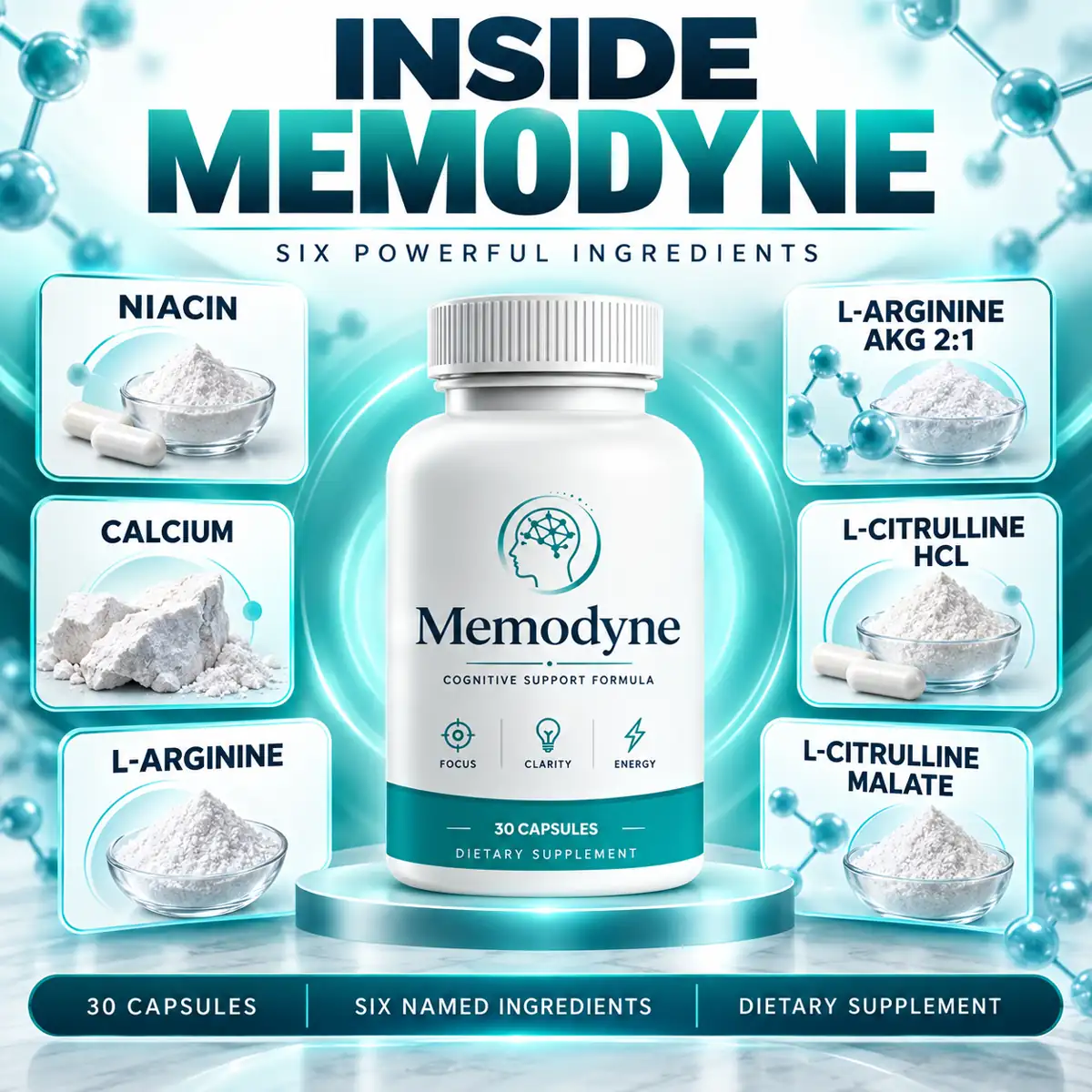
The listing artwork headed Inside Memodyne ranges six tiles around the bottle. One of them, at the lower right, reads L-Citrulline Malate. Directly above it is a separate tile for L-Citrulline HCl. A strip across the foot repeats what the label gives as facts: 30 capsules, six named ingredients, dietary supplement.
There is no Supplement Facts panel on this site, and no tile carries an amount. So for citrulline malate the label offers a name and nothing else. The directions are the same for every ingredient in the capsule: one capsule daily with an 8 oz glass of water, 20 to 30 minutes before a meal, or as directed by a healthcare professional, for adults of 18 and over.
That leaves the published literature as the only place to look for what this name might mean. This piece reads that literature the way a careful shopper would: who was studied, how much they took, and above all what was actually counted at the end of each trial.
This is a dietary supplement, and nothing on this page is medical advice. Where forgetfulness has become the kind other people remark on, the useful next step is an appointment rather than an order; MedlinePlus sets out what is worth raising at one.
What the salt is, and why malate is in it
Citrulline is an amino acid. Malate is the negatively charged form of malic acid, and it is one of the intermediates of the tricarboxylic acid cycle, the loop of reactions inside mitochondria that feeds aerobic energy production. Citrulline malate is simply the two paired in one salt, which is why the sports literature treats it as a single ingredient with two possible jobs.
The citrulline half has a plausible route to a physiological effect. A crossover study in twenty healthy volunteers found that oral citrulline is readily absorbed and at least in part converted to arginine, with the largest dose in that study (3 g twice a day) raising plasma arginine more effectively than arginine itself did. That is the nitric-oxide argument, and it belongs to other pieces in this journal.
The malate half is the subject of this one. If a working muscle is short of tricarboxylic-acid-cycle intermediates, topping them up (chemists call this anaplerosis) could in principle let the cycle run faster and shift the balance of energy production toward the aerobic side. The most direct test of that idea in people is the 2002 magnetic resonance study described below. Everything in it concerns a muscle in the forearm.
The four trials people cite most, one at a time
Four papers turn up again and again when citrulline malate is discussed. Reading each abstract closely takes a few minutes and changes the picture considerably.
| Trial | Who | Amount of the salt | What was counted |
|---|---|---|---|
| Pérez-Guisado and Jakeman, 2010 | 41 men, randomised double-blind crossover | 8 g, single dose | Repetitions to fatigue on the flat barbell bench press at 80% of one-repetition maximum, across 8 sets; muscle soreness at 24 and 48 hours |
| Wax and colleagues, 2015 | 12 advanced resistance-trained men | 8 g | Repetitions to failure over 5 sets each of leg press, hack squat and leg extension at 60% of one-repetition maximum; blood lactate, heart rate, blood pressure |
| Wax and colleagues, 2016 | 14 resistance-trained males | 8 g | Repetitions to failure on chin-ups, reverse chin-ups and push-ups; lactate, heart rate, blood pressure |
| Bendahan and colleagues, 2002 | 18 men complaining of fatigue, no documented disease | 6 g a day for 15 days | Energy metabolism of a forearm finger-flexor muscle, by phosphorus magnetic resonance spectroscopy; sensation of fatigue |
Every figure in this table was read out of the paper’s own abstract on PubMed.
The 2010 study is the source of the most repeated numbers. In the eight-set bench-press protocol the men did more repetitions on citrulline malate from the third set onward, and the abstract reports 52.92% more repetitions in the last set, together with a 40% drop in muscle soreness at 24 and 48 hours. The same abstract records the only side effect: a feeling of stomach discomfort in 14.63% of the subjects. The two studies by Wax and colleagues, both at 8 g, also found more repetitions to failure in trained men, while blood lactate and heart rate did not differ between the citrulline malate and placebo conditions.
The 2002 study is a different kind of experiment altogether. Eighteen men who complained of fatigue but had no documented disease did a rest, exercise (finger flexions) and recovery routine several times before, during and after fifteen days on 6 g a day. The abstract reports a significant reduction in the sensation of fatigue, a 34% increase in the rate of oxidative ATP production during exercise, and a 20% increase in the rate of phosphocreatine recovery after exercise. The authors read this as a larger contribution of aerobic energy production, possibly through the extra malate. The abstract describes the men being measured before and during the supplement period; it does not describe a placebo group, which is one reason the result is best read as an early mechanistic signal.
The trials that found less, or something different
Not every trial in this literature agrees with those four, and the disagreements are informative about how fragile the headline numbers are.
- No performance gain. Twelve recreationally resistance-trained men took 8 g forty minutes before a bench-press protocol of five sets of fifteen repetitions. The authors concluded the dose did not increase exercise performance or muscle swelling, and it did not alter self-rated energy, focus or fatigue.
- No recovery benefit. Nine untrained young men took a single 6 g dose before a high-intensity session and were retested at 24, 48 and 72 hours. Creatine kinase, soreness, lactate, maximum repetitions and perceived exertion showed no treatment effect.
- A gain in women. Fifteen resistance-trained women took 8 g of citrulline malate with 8 g of dextrose against dextrose alone. Upper-body repetitions were 34.1 against 32.9, lower-body 66.7 against 55.1, and perceived exertion was lower in the upper-body exercise.
- A dose question. Twelve trained people took 8 g, 12 g or a placebo an hour before rows and leg presses. Only the 12 g dose produced a significant change, and only on the leg press (estimated repetitions 17 on placebo, 19 on 8 g, 20 on 12 g).
The pattern is one of small samples, single sessions, and results that shift with the exercise chosen. That is normal for sports-supplement research, and it is why the pooled analyses matter.
What the pooled analyses say
Four systematic reviews and meta-analyses have tried to add these small studies together. Their numbers are modest and they are consistent in tone.
| Analysis | What was pooled | Result |
|---|---|---|
| Trexler and colleagues, 2019 | 12 studies, 198 participants; citrulline of at least 3 g taken at least 30 minutes before high-intensity strength or power tests | Standardised difference 0.20 (95% confidence interval 0.01 to 0.39); every individual study’s interval crossed the line of no effect |
| Vårvik, Bjørnsen and Gonzalez, 2021 | 8 studies, 137 strength-trained men; 6 to 8 g taken 40 to 60 minutes before exercise | 3 ± 5 extra repetitions (6.4 ± 7.9%), standardised difference 0.196; the upper-body sub-analysis was not significant |
| Aguiar and Casonatto, 2022 | 4 studies, resistance-trained adults; muscle strength outcomes | No overall effect (0.13, interval −0.21 to 0.46); the authors concluded strength is not improved |
| Wang and colleagues, 2026 | 30 randomised trials, 138 effect sizes, 644 participants; all exercise performance outcomes | Small improvement (g = 0.16); wide prediction intervals; no significant effect on perceived exertion; certainty low to very low |
Figures from each paper’s abstract. A standardised difference of 0.2 is conventionally called small.
Put the 2021 number in plain terms: across protocols that averaged about 51 repetitions, citrulline malate was associated with about three more. The most recent review, from 2026, describes the picture as small and context-dependent, notes that dosing, timing and target populations have not been established, and calls for trials with verified supplement composition. That last phrase is worth noticing in a category where the label itself often does not say how much is inside.
Three meanings of “fatigue”, none of them memory
The word that connects these trials to a memory product is fatigue, and it is doing three different jobs across the papers.
Mechanical fatigue is the point at which a muscle cannot complete another repetition. Repetitions to failure, the workhorse endpoint of the bench-press and leg-press studies, counts this. It is a measurement of a muscle group under load and it has no cognitive component.
Metabolic fatigue is what the 2002 study looked at: how a forearm muscle re-forms phosphocreatine and how much of its ATP comes from oxidative metabolism. It is measured with a spectroscopy scanner pointed at the arm.
The sensation of fatigue is a rating. In the 2002 study it was reduced; the abstract describes previous work as showing an “antiasthenic” effect, meaning against a general feeling of weakness or tiredness. Ratings of perceived exertion in the resistance trials are the same kind of thing. The one trial that asked resistance-trained men to rate their focus before and after exercise, the 2018 bench-press study, found no difference between 8 g and placebo.
A memory test is a different instrument. It asks a person to learn and later recall words, images or a route, and its scoring is described in what a memory test score actually measures, including the practice effects that make a second attempt higher than a first. None of the trials in this piece administered one. A muscle that fatigues later, or a forearm that regenerates phosphocreatine faster, tells you about the muscle. It leaves the question of recall untouched, and any reasoning that carries a result from the first to the second has to be argued rather than assumed.
Marketing is where the argument usually goes missing. “Reduces fatigue” can be read as a statement about arms or about attention, and a reader is invited to hear the second. It is worth asking, each time the word appears, which fatigue and measured how.
Who was in these trials
Most of them enrolled young, trained men, often in groups of a dozen or two, and tested a single dose an hour before a hard session. The 2002 study used men complaining of fatigue and a fifteen-day course. Women are represented in the 2017 trial of fifteen and in a small 2026 pilot, in which twenty physically active women aged 60 to 75 took 3 g a day alongside a six-week exercise programme. That pilot found an improvement in sit-to-stand time in the citrulline malate group, reported no adverse events, and described its own findings as preliminary and hypothesis-generating.
The oldest group in the literature is therefore small, active, and studied for chair-rising and walking, not for recall. A reader who fits none of those descriptions is extrapolating, which is fine as long as it is done knowingly.
The dose gap
The amounts in the trials above are 3 g, 6 g, 8 g and 12 g of the salt. A capsule of the size sold in this category holds well under a gram of powder in total, spread across every ingredient inside it; the arithmetic is set out in what a thirty-capsule bottle can physically hold. The artwork prints no amount for citrulline malate, so this site cannot say where one capsule falls on that scale, and neither can a reader.
None of this proves that a small amount does nothing; nobody has drawn a line below which citrulline malate is inert. It does mean that the published results, obtained at gram doses, cannot be borrowed as a prediction for a capsule whose contents are unstated. The honest description of the gap is that it is unknown.
What would count as evidence for a memory claim
A trial that could support a memory claim for this ingredient would need a handful of features: a placebo; adults who resemble the people buying it; a known amount of the same salt; a period long enough for a daily capsule to matter; and an endpoint that is a memory or cognition test, ideally one with alternate forms so that practice does not masquerade as benefit. The searches run for this piece across PubMed-indexed records found citrulline malate trials in athletes and in fatigued men, and reviews of them, but none built that way.
Absence from a search is not proof of absence from the world, and a trial could be published next month. It is simply where the record stands at the time of writing, and it is why this ingredient is best understood on this label as one of six names rather than as a demonstrated contributor to recall.
How to read a citrulline malate claim
- Ask for the amount. Every trial above used grams of the salt, and a claim with no number attached cannot be checked against them.
- Ask what was counted. Repetitions to failure, soreness and phosphocreatine recovery are muscle measurements; a memory claim needs a memory measurement.
- Look at who was studied. Young trained men in a single session are not a stand-in for a person taking a capsule every morning for a season.
- Look at the size. The pooled effect is small, the certainty is low, and the authors of the newest review say so themselves.
- Keep the routine question separate. A daily capsule can be a habit worth having for its own sake, and that is a decision about the habit, not about this ingredient’s evidence.
The wider question of how the six names relate to one another is covered in four names, one mechanism, and the label’s own gap is set out on ingredients.
Order Memodyne
One capsule a day, thirty to a bottle, six ingredient names on the artwork and no amounts printed beside them. Read the label details on the order page before you buy.
Order Memodyne30 capsules, one each day · adults 18 and over
- Schwedhelm E, Maas R, Freese R, Jung D, Lukacs Z, Jambrecina A, et al. Pharmacokinetic and pharmacodynamic properties of oral L-citrulline and L-arginine: impact on nitric oxide metabolism. Br J Clin Pharmacol. 2008;65(1):51-9. PMID 17662090. https://pubmed.ncbi.nlm.nih.gov/17662090/
- Pérez-Guisado J, Jakeman PM Citrulline malate enhances athletic anaerobic performance and relieves muscle soreness. J Strength Cond Res. 2010;24(5):1215-22. PMID 20386132. https://pubmed.ncbi.nlm.nih.gov/20386132/
- Wax B, Kavazis AN, Weldon K, Sperlak J Effects of supplemental citrulline malate ingestion during repeated bouts of lower-body exercise in advanced weightlifters. J Strength Cond Res. 2015;29(3):786-92. PMID 25226311. https://pubmed.ncbi.nlm.nih.gov/25226311/
- Wax B, Kavazis AN, Luckett W Effects of Supplemental Citrulline-Malate Ingestion on Blood Lactate, Cardiovascular Dynamics, and Resistance Exercise Performance in Trained Males. J Diet Suppl. 2016;13(3):269-82. PMID 25674699. https://pubmed.ncbi.nlm.nih.gov/25674699/
- Bendahan D, Mattei JP, Ghattas B, Confort-Gouny S, Le Guern ME, Cozzone PJ Citrulline/malate promotes aerobic energy production in human exercising muscle. Br J Sports Med. 2002;36(4):282-9. PMID 12145119. https://pubmed.ncbi.nlm.nih.gov/12145119/
- Gonzalez AM, Spitz RW, Ghigiarelli JJ, Sell KM, Mangine GT Acute Effect of Citrulline Malate Supplementation on Upper-Body Resistance Exercise Performance in Recreationally Resistance-Trained Men. J Strength Cond Res. 2018;32(11):3088-3094. PMID 29210953. https://pubmed.ncbi.nlm.nih.gov/29210953/
- da Silva DK, Jacinto JL, de Andrade WB, Roveratti MC, Estoche JM, Balvedi MCW, et al. Citrulline Malate Does Not Improve Muscle Recovery after Resistance Exercise in Untrained Young Adult Men. Nutrients. 2017;9(10):1132. PMID 29057836. https://pubmed.ncbi.nlm.nih.gov/29057836/
- Glenn JM, Gray M, Wethington LN, Stone MS, Stewart RW Jr, Moyen NE Acute citrulline malate supplementation improves upper- and lower-body submaximal weightlifting exercise performance in resistance-trained females. Eur J Nutr. 2017;56(2):775-784. PMID 26658899. https://pubmed.ncbi.nlm.nih.gov/26658899/
- Gough LA, Tan R, Bailey SJ, Perrin C, Roberts CJ, Gibbons F The Comparative Effect of Acute Moderate- and High-Dose Citrulline Malate on Resistance Exercise Performance in Trained Individuals: A Double-Blind Randomised Controlled Pilot Trial. J Funct Morphol Kinesiol. 2026;11(1):5. PMID 41900522. https://pubmed.ncbi.nlm.nih.gov/41900522/
- Trexler ET, Persky AM, Ryan ED, Schwartz TA, Stoner L, Smith-Ryan AE Acute Effects of Citrulline Supplementation on High-Intensity Strength and Power Performance: A Systematic Review and Meta-Analysis. Sports Med. 2019;49(5):707-718. PMID 30895562. https://pubmed.ncbi.nlm.nih.gov/30895562/
- Vårvik FT, Bjørnsen T, Gonzalez AM Acute Effect of Citrulline Malate on Repetition Performance During Strength Training: A Systematic Review and Meta-Analysis. Int J Sport Nutr Exerc Metab. 2021;31(4):350-358. PMID 34010809. https://pubmed.ncbi.nlm.nih.gov/34010809/
- Aguiar AF, Casonatto J Effects of Citrulline Malate Supplementation on Muscle Strength in Resistance-Trained Adults: A Systematic Review and Meta-Analysis of Randomized Controlled Trials. J Diet Suppl. 2022;19(6):772-790. PMID 34176406. https://pubmed.ncbi.nlm.nih.gov/34176406/
- Wang X, Fan X, Chang J, Li H, Zhang X, Zhang Y, et al. Effects of Citrulline Malate Supplementation on Exercise Performance: A Systematic Review and Three-Level Meta-Analysis. Nutrients. 2026;18(12):1881. PMID 42356270. https://pubmed.ncbi.nlm.nih.gov/42356270/
- Ramos-Hernández R, Pascual-Fernández J, Álvarez-Pardo S, Fernández-Lázaro D, Martínez-Ferrán M, Busto N, et al. Short-term citrulline malate supplementation enhances lower-limb function in physically active older women: A pilot randomized controlled trial. Clin Nutr ESPEN. 2026;74:103356. PMID 42162613. https://pubmed.ncbi.nlm.nih.gov/42162613/