Memodyne Official Website › Journal › Mechanism
MechanismTwo routes to nitric oxide: the amino acid route on this label and the vegetable route it leaves out
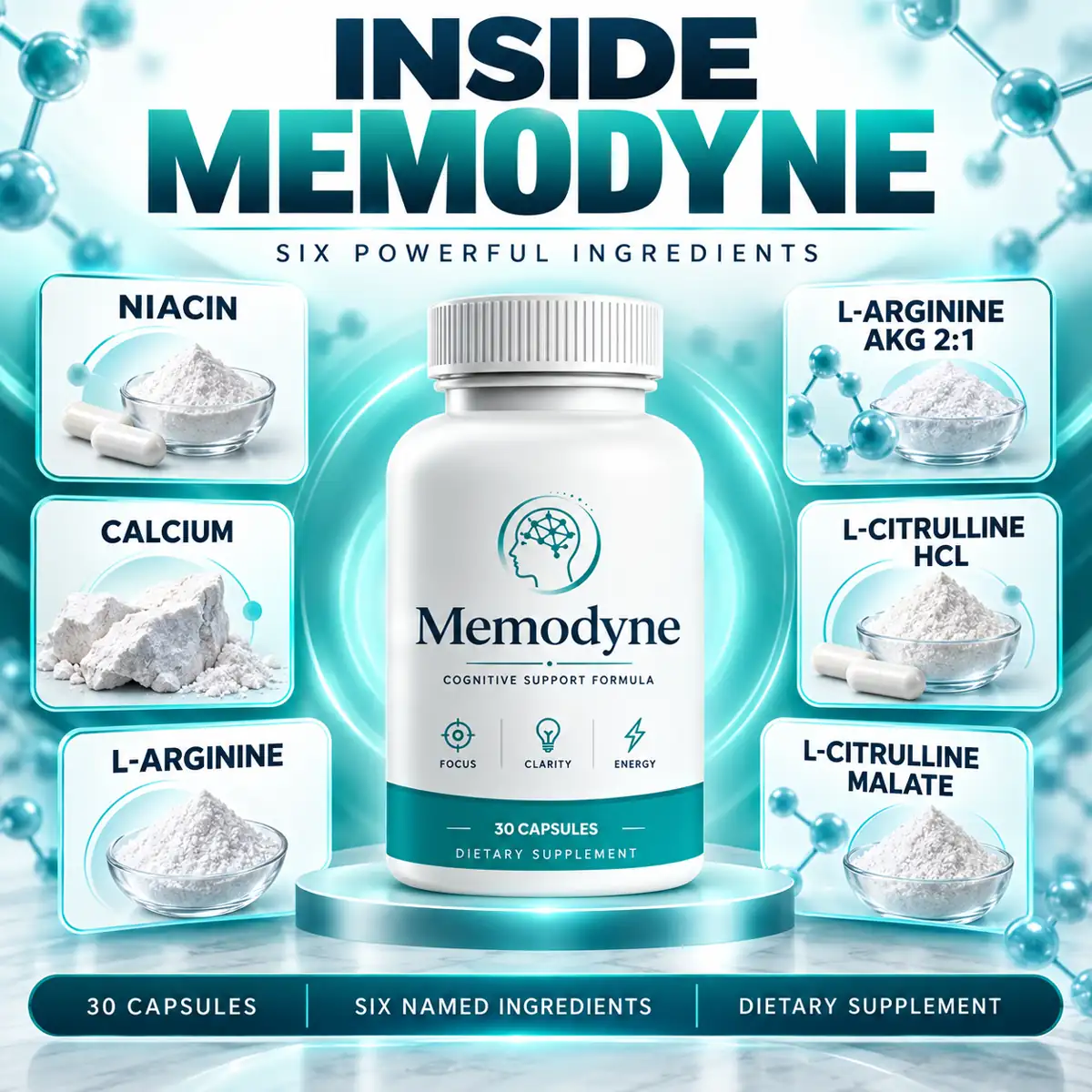
Four of the six names on the Memodyne artwork are ways of feeding one route to nitric oxide: the one that starts with the amino acid arginine. The body has a second route that starts with nitrate, the compound in leafy vegetables and beetroot, and it has been tested against brain measures more directly than the amino acid route has. This piece sets the two routes side by side, reports what each set of trials found, and notes the one place they have been combined.
One molecule, two ways to make it
Nitric oxide is a small gas that the body makes for a job it needs done constantly: telling the muscle in the wall of a blood vessel to relax. When the vessel relaxes it widens and more blood flows. That is the whole reason it appears on a memory label, since the argument for it runs through blood flow rather than through anything the brain does directly with the molecule.
For decades the story of how the body makes it was a single story. An enzyme called nitric oxide synthase takes the amino acid arginine and turns it into nitric oxide. A review of arginine's pharmacology puts it simply: arginine is a precursor for nitric oxide synthesis, and the synthases are a family of enzymes. Everything on the Memodyne label that has to do with nitric oxide belongs to that story, and the article on four names and one mechanism counts how many of the six names are entrances to it.
Then a second story arrived. In 2008 a review in Nature Reviews Drug Discovery pointed out that nitrate and nitrite, the inorganic anions once assumed to be inert waste from nitric oxide metabolism, can be recycled in the body to form nitric oxide. The authors called this an important alternative source to the classical arginine-synthase pathway, particularly when tissue oxygen is low. They discussed the therapeutic potential of nitrate and nitrite in conditions including heart attack, stroke, high blood pressure and stomach ulcers.
Those two routes are the subject of this article. One is what this label is built on. The other is in the vegetable drawer.
This is a dietary supplement website, and nothing on this page is medical advice. Anyone taking prescribed medicine for blood pressure or the heart should raise any product that acts on blood vessels, capsule or food, with whoever prescribes for them. Where forgetfulness has become the kind other people remark on, the useful next step is an appointment rather than an order; MedlinePlus sets out what is worth raising at one.
Route one: the amino acid route on this label
Arginine has an awkward property when swallowed. The lining of the gut is rich in an enzyme that breaks it down, which is why oral arginine trials are counted in grams. Citrulline is the workaround: it is absorbed intact and at least partly converted to arginine in the body. A randomised, double-blind, placebo-controlled crossover study in 20 healthy volunteers tested six dosing regimes of placebo, citrulline and arginine, each for a week. Citrulline raised the plasma arginine concentration more effectively than arginine itself did. On the top regime, 3 g twice a day, the ratio of arginine to its natural blocker ADMA rose from 186 to 278, and urinary nitrate and cyclic GMP, two signs of nitric oxide signalling, went up too. Flow-mediated dilation, a measure of how well an artery widens, did not improve over baseline in any regime.
That study is a good summary of the route's strengths and limits. The chain works, and it can be measured. Turning it into a change a person could feel was not demonstrated in that trial, and the amounts involved were grams, which the artwork for this product does not claim to reach and which the article on what a bottle can hold weighs against the capsule.
The pharmacology review adds a caution about who responds. Arginine appears to have no effect in people whose ADMA levels are low, and to restore the arginine-to-ADMA ratio only in people whose levels are high. Doses of 3 to 8 g a day appear safe in humans, the review says, though in one trial the arginine group had higher mortality than placebo. The route has real chemistry behind it and a patchy record of turning that chemistry into outcomes.
Where it has been pointed at a memory screen, the record is two small trials. One gave 72 frail, hypertensive older adults 1.66 g of arginine twice a day for four weeks and reported a difference on the Montreal Cognitive Assessment against placebo. A 2026 pilot gave adults aged 60 and over with cognitive complaints 6.4 g a day for 30 days and reported more people scoring in the normal range on arginine than on placebo. Both were small, both were short, and neither has been repeated by an independent group.
Route two: nitrate from vegetables
The vegetable route works differently. Nitrate is eaten, in leafy greens, in beetroot and in many other vegetables, and it is reduced in the body to nitrite and then to nitric oxide. One paper on the subject describes it as nitrate derived from vegetables that is consumed as part of a normal diet and reduced endogenously via nitrite. Because it does not depend on the synthase enzyme, it is an alternative source, which is the reason the 2008 review stressed low-oxygen conditions.
Three trials have tested that route against measures of the brain, and they are worth setting out in order, because they do not agree.
- Presley and colleagues, 2011. Older adults, average age 74.7, were given a high-nitrate diet and a low-nitrate diet, and the researchers measured blood flow through the brain with an MRI technique called arterial spin labelling. The high-nitrate diet did not change flow through the brain as a whole. It did increase flow in one region, the white matter of the frontal lobe, especially between the dorsolateral prefrontal cortex and the anterior cingulate cortex, areas known to be involved in executive function. The authors concluded that dietary nitrate may be useful for improving regional brain perfusion in older adults.
- Wightman and colleagues, 2015. Forty healthy adults took either a placebo or 450 ml of beetroot juice, about 5.5 mmol of nitrate, and after a 90-minute absorption period did a set of tasks that engage the frontal cortex while near-infrared spectroscopy tracked blood flow. Nitrate changed the blood-flow response during the tasks, and cognitive performance improved on one of the three tasks, serial subtraction of threes. The authors suggested this was a possible mechanism by which eating vegetables benefits the brain.
- Babateen and colleagues, 2022. Sixty-two overweight or obese older adults aged 60 to 75 took beetroot juice for 13 weeks at one of three nitrate doses, from 70 ml on alternate days to 70 ml twice a day, or a nitrate-depleted placebo. Cognitive function and frontal blood flow were not affected at any dose. The authors described it as a pilot and asked for larger studies using MRI.
To put the middle dose in familiar units, 5.5 mmol of nitrate is roughly 341 mg, using the ion's molecular weight of 62.005 from the PubChem chemical database. That is about a third of a gram, delivered as a drink. It is the same order of magnitude as the 200 mg and 500 mg nitrate doses used in the two combination studies below, and it is the kind of amount a capsule can carry more easily than several grams of an amino acid.
Part of the disagreement between those three trials may come from what was measured and in whom. The 2011 study used MRI, which looks at flow through the brain as a whole and in named regions. The two later trials used near-infrared spectroscopy, which reads blood-oxygen changes in the frontal cortex through the scalp and is a narrower window. Their populations differed as well: older adults on a controlled diet for a short spell, healthy adults after a single drink, and overweight older adults over 13 weeks. The Babateen authors themselves asked for larger studies with MRI before drawing conclusions, which is the fair reading of all three.
The two routes side by side
| Amino acid route (this label) | Nitrate route (vegetables) | |
|---|---|---|
| Starting compound | Arginine, or citrulline converted to arginine | Nitrate, reduced to nitrite, then to nitric oxide |
| Needs the synthase enzyme? | Yes | No |
| Strongest published measure | Plasma arginine, blood pressure, arginine-to-ADMA ratio | Regional brain blood flow on MRI and near-infrared scans |
| Cognitive test evidence | Two small trials of arginine in older adults | One task improved acutely; no effect over 13 weeks |
| Usual amounts in trials | Grams a day | Roughly 200 to 500 mg of nitrate in the studies below |
Summaries are drawn from the abstracts of the studies cited on this page. No trial of the Memodyne capsule exists, and the label prints no amounts.
Look at the two columns and one thing stands out. The route this label is built on is the one that has been measured mainly in blood and in blood pressure, and the route it is not built on is the one that has been pointed at the brain with scanners. Neither has produced a clear, repeated improvement in how people think, and the one long trial of the vegetable route found nothing.
Have the two routes been combined?
Yes, but not for memory. Athletes, always the first customers for anything that might move blood, have been given both. In a 2024 randomised crossover trial, 20 elite male rowers spent a week on a placebo, on beetroot extract providing 500 mg of nitrate, and on that extract plus 6 g of citrulline. Lactate cleared better and peak power in one test was higher with the combination, and nothing else differed. A 2021 trial in 32 male triathletes gave 3 g a day of citrulline with 2.1 g of beetroot extract, providing 300 mg of nitrate, for nine weeks, and found improved aerobic power against the other groups.
In a different population, 18 abdominally obese men were given a high-fat meal with beetroot powder providing 200 mg of nitrate, with or without 0.8 g or 1.5 g of arginine, or 3.0 g of arginine alone, and had the widening of an artery measured two hours later. There were no significant differences between the meals, and the authors said the trial could not show an additive benefit of the combination.
So the combination exists in the literature, in sport and in vascular tests, and it has produced modest and inconsistent results. It has not been tested against a memory test in anyone, and it is not what this label contains. The label's four nitric oxide names are all on the amino acid side.
What this means for a buyer
Three practical points come out of the comparison, and none of them needs a capsule.
- The vegetable route is already in most diets. Nitrate from vegetables is eaten as part of a normal diet, in the words of the Wightman paper. Nothing in these trials supports a claim that eating more vegetables will change a memory test score, and nothing supports the opposite, but the diet has other reasons to be varied.
- Route matters less than measured outcome. A product that starts with either route is asking to be judged on what happens to blood flow and, more importantly, on what happens to thinking, and for both routes the second question has small and mixed answers.
- Medicines come first. Anything that acts on blood vessels, from a capsule to a daily beetroot drink, is worth mentioning to a prescriber if you take medicine for blood pressure or the heart. That is what the label itself says about medicines, and it applies to both routes equally.
What remains unknown
The honest inventory is short. It is not known whether raising nitric oxide by either route improves memory in a healthy adult, because no trial has tested a supplement of either kind against a proper memory outcome for long enough. It is not known whether the two routes add together, or whether the amino acid route in a capsule reaches a useful amount at all, because the artwork prints no amount to test. And it is not known who, if anyone, is the person most likely to benefit: the older adults in the brain-perfusion studies, the people with low nitric oxide in the pharmacology review, or nobody.
What is known is smaller and more useful. The two routes exist. The label sits on one of them. The evidence for that one is mostly about blood pressure and blood markers. And the sixty days from purchase are a fair window to run your own test, following the steps in the article on buying without numbers, with a written question and a fixed date.
Order Memodyne from the official U.S. shop
One capsule a day, thirty to a bottle, six names on the artwork and no amounts beside them. Two bottles, three or six, each paid for once, with sixty days from the date of purchase to change your mind.
Two bottles $158 · six bottles $294 · 60 days from purchase
Order Memodyne From This ShopLot MEM-26/ME-6233 · 30 capsules, one each morning · dispatched from within the United States
- Lundberg JO, Weitzberg E, Gladwin MT. The nitrate-nitrite-nitric oxide pathway in physiology and therapeutics. Nat Rev Drug Discov. 2008;7(2):156-67. PMID 18167491. https://pubmed.ncbi.nlm.nih.gov/18167491/
- Schwedhelm E, Maas R, Freese R, Jung D, Lukacs Z, Jambrecina A, et al. Pharmacokinetic and pharmacodynamic properties of oral L-citrulline and L-arginine: impact on nitric oxide metabolism. Br J Clin Pharmacol. 2008;65(1):51-9. PMID 17662090. https://pubmed.ncbi.nlm.nih.gov/17662090/
- Böger RH. The pharmacodynamics of L-arginine. J Nutr. 2007;137(6 Suppl 2):1650S-1655S. PMID 17513442. https://pubmed.ncbi.nlm.nih.gov/17513442/
- Mone P, Pansini A, Jankauskas SS, Varzideh F, Kansakar U, Lombardi A, et al. L-Arginine Improves Cognitive Impairment in Hypertensive Frail Older Adults. Front Cardiovasc Med. 2022;9:868521. PMID 35498050. https://pubmed.ncbi.nlm.nih.gov/35498050/
- Teotia S, Rana AK, Gupta V. Comparison of the Safety and Efficacy of Oral L-arginine for the Treatment of Cognitive Impairment in Older Adults: A Prospective, Randomized, Placebo-Controlled Pilot Study. Cureus. 2026;18(7):e112987. PMID 42621366. https://pubmed.ncbi.nlm.nih.gov/42621366/
- Presley TD, Morgan AR, Bechtold E, Clodfelter W, Dove RW, Jennings JM, et al. Acute effect of a high nitrate diet on brain perfusion in older adults. Nitric Oxide. 2011;24(1):34-42. PMID 20951824. https://pubmed.ncbi.nlm.nih.gov/20951824/
- Wightman EL, Haskell-Ramsay CF, Thompson KG, Blackwell JR, Winyard PG, Forster J, et al. Dietary nitrate modulates cerebral blood flow parameters and cognitive performance in humans: A double-blind, placebo-controlled, crossover investigation. Physiol Behav. 2015;149:149-58. PMID 26037632. https://pubmed.ncbi.nlm.nih.gov/26037632/
- Babateen AM, Shannon OM, O'Brien GM, Okello E, Smith E, Olgacer D, et al. Incremental Doses of Nitrate-Rich Beetroot Juice Do Not Modify Cognitive Function and Cerebral Blood Flow in Overweight and Obese Older Adults: A 13-Week Pilot Randomised Clinical Trial. Nutrients. 2022;14(5). doi:10.3390/nu14051052. PMID 35268027. https://pubmed.ncbi.nlm.nih.gov/35268027/
- Viribay A, Alcantara JMA, López I, Mielgo-Ayuso J, Castañeda-Babarro A. Impact of a short-term nitrate and citrulline co-supplementation on sport performance in elite rowers: a randomized, double-blind, placebo-controlled crossover trial. Eur J Appl Physiol. 2024;124(6):1911-1923. PMID 38340156. https://pubmed.ncbi.nlm.nih.gov/38340156/
- Burgos J, Viribay A, Fernández-Lázaro D, Calleja-González J, González-Santos J, Mielgo-Ayuso J. Combined Effects of Citrulline Plus Nitrate-Rich Beetroot Extract Co-Supplementation on Maximal and Endurance-Strength and Aerobic Power in Trained Male Triathletes: A Randomized Double-Blind, Placebo-Controlled Trial. Nutrients. 2021;14(1). doi:10.3390/nu14010040. PMID 35010917. https://pubmed.ncbi.nlm.nih.gov/35010917/
- Smeets ETHC, Mensink RP, Hoeks J, de Vogel-Van den Bosch J, Hageman RJJ, Joris PJ. Effects of Beetroot Powder with or without L-Arginine on Postprandial Vascular Endothelial Function: Results of a Randomized Controlled Trial with Abdominally Obese Men. Nutrients. 2020;12(11). doi:10.3390/nu12113520. PMID 33207606. https://pubmed.ncbi.nlm.nih.gov/33207606/
- Nitrate. PubChem compound record CID 943, molecular weight 62.005, National Center for Biotechnology Information. https://pubchem.ncbi.nlm.nih.gov/compound/943