What Arginine And Citrulline Do To Blood Pressure In Pooled Trials, And Why That Is Not A Memory Result
Pooled trials of oral arginine and citrulline report average blood-pressure falls of roughly 2 to 5 mm Hg at doses of 3 to 24 g a day. Those are cardiovascular results. The studies that came closest to the brain were small pilots, and the artwork prints no amount for any of these names.
The claim being tested
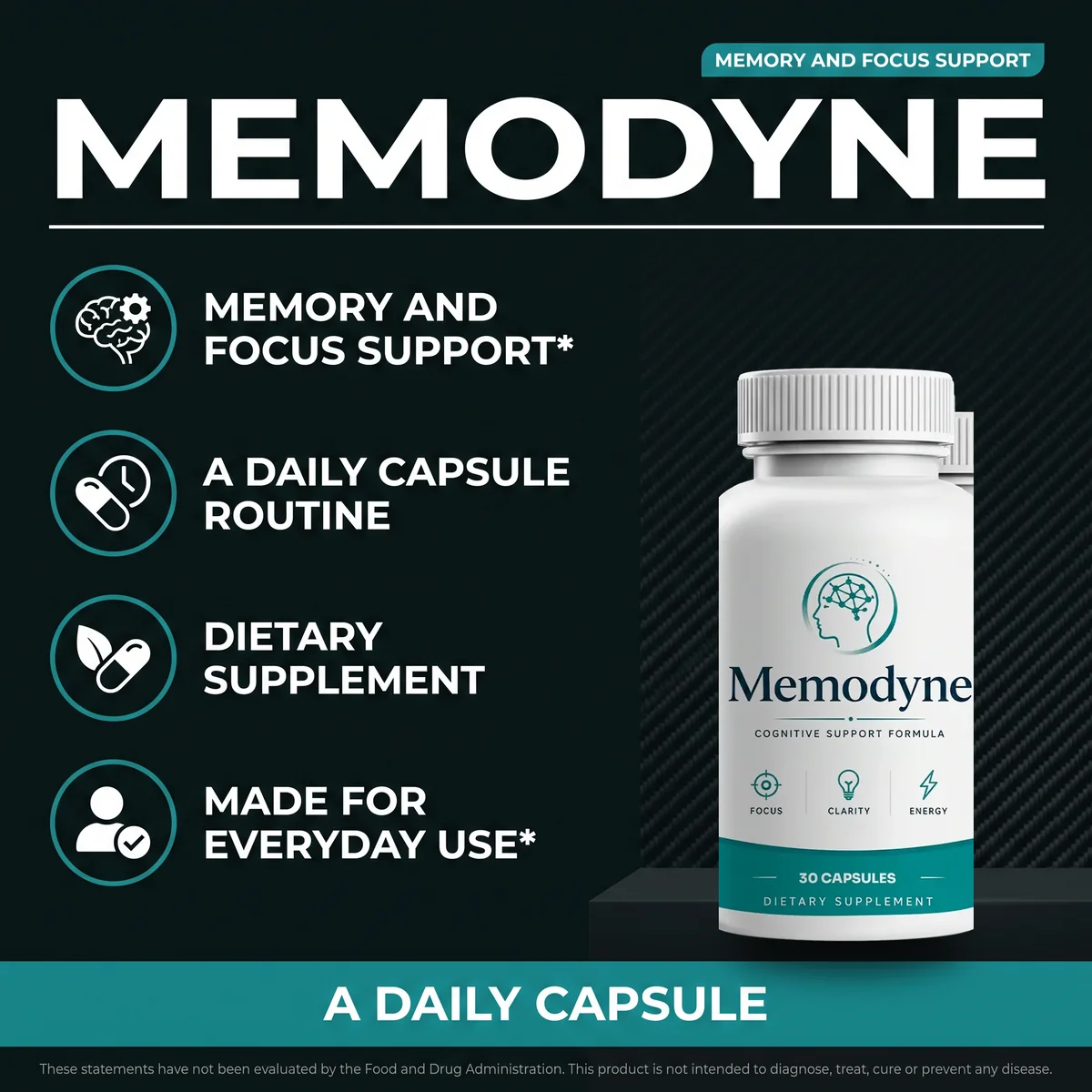
Memodyne’s artwork names four amino-acid ingredients that all feed one pathway: L-arginine, L-arginine AKG 2:1, L-citrulline HCl and L-citrulline malate. The pathway is the one that ends in nitric oxide, and its best-documented human effect is on blood pressure. The bottle is sold under the words Memory and Focus Support, so a natural question is how far a blood-pressure result travels toward a memory result.
This piece takes the blood-pressure evidence first, at full size, and then follows it as far toward the brain as the published trials allow. It does not revisit the separate route to nitric oxide from vegetable nitrate, which two routes to nitric oxide covers. And it holds to one rule about the label: the artwork prints no amount beside any of these names and there is no Supplement Facts panel on this site, so nothing below is an estimate of what one capsule contains.
This is a dietary supplement, and nothing on this page is medical advice. Where forgetfulness has become the kind other people remark on, the useful next step is an appointment rather than an order; MedlinePlus sets out what is worth raising at one.
The endothelial logic, in one section
Blood vessels are lined with a thin layer of cells called the endothelium. An enzyme in those cells, endothelial nitric oxide synthase, makes nitric oxide from arginine. Nitric oxide diffuses into the smooth muscle around the vessel, which relaxes; a wider vessel offers less resistance and, other things equal, lower pressure. That is the whole mechanism in four sentences, and it is why arginine has been tried against blood pressure for decades.
Two complications are worth knowing, because they explain why results vary. First, a review by Böger notes that about 5 g of arginine is eaten each day in a normal Western diet and that plasma arginine is not much reduced in most diseases. Whether supplemental arginine helps seems to depend on an endogenous inhibitor of the enzyme called asymmetric dimethylarginine, or ADMA. In that review’s reading, arginine appears to exert no effect in people with low ADMA, while in people with high ADMA it restores the arginine-to-ADMA ratio and normalises endothelial function.
Second, plain arginine is partly destroyed on the way in. The authors of a crossover study in twenty healthy volunteers begin from the point that arginine treatment is hampered by extensive presystemic elimination by intestinal arginase, whereas citrulline is readily absorbed and at least partly converted to arginine. In that study, citrulline raised plasma arginine dose-dependently and more effectively than arginine did; the top dose (3 g twice a day for a week) improved the arginine-to-ADMA ratio from 186 to 278 and raised urinary nitrate and cGMP, a marker of nitric-oxide signalling. Yet no treatment improved flow-mediated dilation, the standard test of vessel widening, over baseline. Chemistry moved; the vessel test did not.
Arginine, pooled
The best-known synthesis is a 2011 meta-analysis by Dong and colleagues in the American Heart Journal. It pooled 11 randomised, double-blind, placebo-controlled trials with 387 participants, in which oral arginine ranged from 4 to 24 g a day. Compared with placebo, arginine lowered systolic pressure by 5.39 mm Hg (95% confidence interval 2.25 to 8.54) and diastolic pressure by 2.66 mm Hg (1.54 to 3.77). Restricting to trials of four weeks or longer, or to those whose participants did not take blood-pressure medicine, gave similar results. Baseline systolic pressure showed an inverse but not statistically significant relationship with the size of the fall, so the paper cannot say the effect is larger in people who start higher.
A newer analysis narrowed the question to ambulatory blood pressure, measured over a day rather than in a clinic. Shi and colleagues, in 2026, pooled five randomised trials with 202 participants and found 24-hour systolic pressure lower by 4.23 mm Hg (2.58 to 5.87) and 24-hour diastolic by 3.04 mm Hg (1.59 to 4.48), with a larger fall at night: 5.70 mm Hg systolic and 4.18 mm Hg diastolic. The authors themselves note that the number of studies was limited and that further validation is needed.
Citrulline, pooled
For citrulline the anchor is Barkhidarian and colleagues, 2019. They searched from inception to November 2017, screened 811 papers and included eight trials contributing ten data sets. Sample sizes ranged from 12 to 34 people, mean ages from 22 to 71, doses from 3 to 9 g a day and durations from one to seventeen weeks. Pooled, systolic pressure fell by 4.10 mm Hg (95% confidence interval 0.26 to 7.94, p = 0.037) and diastolic by 2.08 mm Hg (interval running from 4.32 lower to 0.16 higher, p = 0.069), which is not statistically significant. In the subgroup taking 6 g a day or more, diastolic pressure fell by a significant 2.75 mm Hg.
A 2025 analysis by Luo and colleagues focused on middle-aged and older adults and combined citrulline with watermelon intake, a food source of the amino acid. It pooled 15 trials in 24 data sets with 415 participants and found systolic pressure lower by 4.02 mm Hg (1.50 to 6.54) and diastolic lower by 2.54 mm Hg (0.81 to 4.27). Within it, a subgroup that combined citrulline and arginine showed a systolic fall of 10.44 mm Hg. That subgroup is a slice of a small set of trials, and a subgroup is where surprises are most often found by chance; the result is interesting rather than settled.
| Pooled analysis | Trials and people | Amount and duration | Systolic / diastolic change |
|---|---|---|---|
| Arginine, Dong 2011 | 11 trials, 387 people | 4 to 24 g a day | −5.39 / −2.66 mm Hg |
| Arginine, Shi 2026 (24-hour ambulatory) | 5 trials, 202 people | Not broken down in the abstract | −4.23 / −3.04 mm Hg |
| Citrulline, Barkhidarian 2019 | 8 trials (10 data sets), samples of 12 to 34 | 3 to 9 g a day, 1 to 17 weeks | −4.10 / −2.08 mm Hg (diastolic not significant) |
| Citrulline and watermelon, Luo 2025 | 15 trials (24 data sets), 415 people, middle-aged and older | Not broken down in the abstract | −4.02 / −2.54 mm Hg |
Figures from each paper’s abstract. Confidence intervals are in the text above.
Reading a few millimetres of mercury
All four systolic figures in that table sit between about 4 and 5.4 mm Hg. They come from trials that were small, from a dozen to a few dozen people each in the citrulline set, and the lower end of the citrulline systolic interval (0.26 mm Hg) is barely away from zero. The diastolic citrulline result crosses zero altogether. None of this is a reason to dismiss the finding; the direction is consistent across analyses. It is a reason to read it as a modest average effect with real uncertainty about its size.
There is also what the abstracts do not say. They do not tell a reader how many of the trial participants were healthy, how many had high pressure, or how many were on medication, beyond Dong’s check that the result held in people not using blood-pressure medicine. A pooled average blends whoever was enrolled. So the numbers describe what happened across a mix of trials, and a reader whose blood pressure is normal cannot assume their own would move by the same amount, or at all.
Finally, the point is not that the supplement result is unreal. It is that a blood-pressure change of this size is a measurement about the cardiovascular system, and the next sections are about how many steps lie between it and recall.
The dose gap
The amounts behind these pooled results range from 3 to 24 g a day. A capsule of the kind used in this category holds well under a gram of powder in total, shared among all six ingredients; see what a thirty-capsule bottle can physically hold for the arithmetic. The artwork prints no amount for arginine, arginine AKG, citrulline HCl or citrulline malate, so a reader cannot tell where one capsule falls on the scales above, and this site will not guess.
That does not make a capsule inert. It means that the meta-analyses cannot be used as a forecast for a product whose contents are unstated, and that a buyer who wants the blood-pressure result the papers describe would be relying on numbers the label does not supply.
From a blood-pressure number to a memory result
Suppose the blood-pressure effect is real at the label’s dose. What would have to be true for it to help recall? The chain has at least three links, and each is a separate empirical question.
Link one: blood pressure to brain blood flow. Systemic pressure and blood flow in the brain are related but not the same. The brain circulation has its own regulation, and a small fall in arm blood pressure does not by itself tell you what happened to perfusion in the parts of the brain that handle memory.
Link two: brain blood flow to memory. Even where flow rises, whether performance on a memory task follows is a further question, and it has to be answered with a memory test in a controlled trial.
Link three: a short effect to a lasting one. A vessel test measured over hours is not a cognitive outcome measured over months.
What lowering blood pressure with drugs has done for cognition
The nearest large body of evidence is not about supplements at all. It is about antihypertensive drugs. A meta-analysis of randomised trials by Hughes and colleagues in JAMA in 2020 pooled 14 trials with 96,158 participants, whose mean baseline systolic pressure was 154 mm Hg and whose follow-up averaged about four years. Blood-pressure lowering was associated with a lower risk of dementia or cognitive impairment (7.0% against 7.5%; odds ratio 0.93, 95% confidence interval 0.88 to 0.98), an absolute reduction of 0.39 percentage points. The same review found that blood-pressure lowering was not significantly associated with a change in cognitive test scores.
The trial most often cited in this connection is SPRINT MIND, which randomised 9,361 adults aged 50 or over with hypertension to a systolic target below 120 or below 140 mm Hg. Over a median follow-up of about five years, probable dementia occurred at a rate that was not significantly different (hazard ratio 0.83, 95% confidence interval 0.67 to 1.04), while mild cognitive impairment was less frequent with the lower target (hazard ratio 0.81, 0.69 to 0.95). The authors noted that early termination and fewer dementia cases than expected may have left the trial underpowered.
Two things follow, and both are worth saying briefly. These were treat-to-target trials in people with high pressure, using medicines, over years. They are the closest thing available to a test of the idea that lowering pressure protects cognition, and they returned a small effect on diagnoses and none on test scores. A supplement that moves pressure by a few millimetres in a mixed population is a long way from either the population or the intervention.
The brain-flow and memory trials on the arginine route
Three small studies have looked more directly.
- Citrulline and cerebrovascular function. Twenty male taekwondo athletes aged 18 to 30 took 8.8 g of L-citrulline or placebo for five days in a crossover design, then did four 30-second maximal sprints. Transcranial Doppler measured cerebrovascular function; one index, the change in breath-holding response, improved (P = 0.037), while pulse index did not and sprint power did not differ. It is a vessel-response result in young athletes, and no memory test was given.
- Arginine in combination. Ten people with mild Alzheimer’s disease or mild cognitive impairment were treated in sequence with simvastatin, then arginine, then tetrahydrobiopterin, and brain blood flow rose about 13% to 15% by week 8 with a small rise in the Mini-Mental State Examination from 24.2 to 26.0 by week 16. It was a proof-of-concept study with no comparison group described in the abstract and three agents given in order, so nothing in it can be assigned to arginine alone.
- Arginine alone, and a practice-effect lesson. In a 2026 pilot, 38 people aged 60 or over with cognitive complaints took 6.4 g a day of arginine or placebo for 30 days, and 35 completed. Memory scores on the Addenbrooke’s Cognitive Examination improved in both groups (p < 0.001 with arginine, p = 0.003 with placebo), and more people on arginine reached a normal total score (37.5% against 5.3%, p = 0.032). The authors call for larger and longer trials.
The third result is the most instructive one. A memory score that rose in the placebo group is exactly what the practice-effects literature predicts, as described in what a memory test score actually measures, and it is why a within-group improvement, taken alone, is not evidence of anything. The between-group comparison is the informative one, and in a trial of 35 finishers, with a 6.4 g dose and 30 days, it is a lead worth following rather than a conclusion.
What it adds up to
- Oral arginine and citrulline have been associated with average blood-pressure falls of roughly 2 to 5 mm Hg in pooled trials, at gram doses, with wide uncertainty and mixed populations.
- None of those trials had a memory outcome, and the pooled results say nothing about recall.
- The best-tested route from lower blood pressure to protected cognition, antihypertensive drugs, showed a small effect on diagnoses and none on test scores.
- The studies that look at brain flow or memory directly on this pathway are small, short, and in one case run without a comparison group, so they should be read as hypotheses.
- The artwork prints no amount, so a capsule cannot be placed on any of these scales.
None of this means the pathway is irrelevant to the brain, and it does not mean the capsule has no effect. It means the gap between what has been measured and what the name on the bottle implies is wide, and that the honest way to describe a nitric-oxide ingredient list is as an established blood-pressure story with an unproven memory sequel. For how the four names relate as a group, see four names, one mechanism.
Order Memodyne
One capsule a day, thirty to a bottle, six ingredient names on the artwork and no amounts printed beside them. Read the label details on the order page before you buy.
Order Memodyne30 capsules, one each day · adults 18 and over
- Böger RH The pharmacodynamics of L-arginine. J Nutr. 2007;137(6 Suppl 2):1650S-1655S. PMID 17513442. https://pubmed.ncbi.nlm.nih.gov/17513442/
- Schwedhelm E, Maas R, Freese R, Jung D, Lukacs Z, Jambrecina A, et al. Pharmacokinetic and pharmacodynamic properties of oral L-citrulline and L-arginine: impact on nitric oxide metabolism. Br J Clin Pharmacol. 2008;65(1):51-9. PMID 17662090. https://pubmed.ncbi.nlm.nih.gov/17662090/
- Dong JY, Qin LQ, Zhang Z, Zhao Y, Wang J, Arigoni F, et al. Effect of oral L-arginine supplementation on blood pressure: a meta-analysis of randomized, double-blind, placebo-controlled trials. Am Heart J. 2011;162(6):959-65. PMID 22137067. https://pubmed.ncbi.nlm.nih.gov/22137067/
- Shi Y, Liu Y, Zhou Z, Xu S, Luo P Reassessment of the effect of oral l-arginine on blood pressure: A systematic review and meta-analysis based on ambulatory blood pressure monitoring. Nitric Oxide. 2026;164:60-68. PMID 42520885. https://pubmed.ncbi.nlm.nih.gov/42520885/
- Barkhidarian B, Khorshidi M, Shab-Bidar S, Hashemi B Effects of L-citrulline supplementation on blood pressure: A systematic review and meta-analysis. Avicenna J Phytomed. 2019;9(1):10-20. PMID 30788274. https://pubmed.ncbi.nlm.nih.gov/30788274/
- Luo P, Chen J, Liu K, Zhang J Does l-citrulline supplementation and watermelon intake reduce blood pressure in middle-aged and older adults? A systematic review and meta-analysis of randomized controlled trials. Clin Nutr ESPEN. 2025;69:653-664. PMID 40789388. https://pubmed.ncbi.nlm.nih.gov/40789388/
- Hughes D, Judge C, Murphy R, Loughlin E, Costello M, Whiteley W, et al. Association of Blood Pressure Lowering With Incident Dementia or Cognitive Impairment: A Systematic Review and Meta-analysis. JAMA. 2020;323(19):1934-1944. PMID 32427305. https://pubmed.ncbi.nlm.nih.gov/32427305/
- SPRINT MIND Investigators for the SPRINT Research Group, Williamson JD, Pajewski NM, et al. Effect of Intensive vs Standard Blood Pressure Control on Probable Dementia: A Randomized Clinical Trial. JAMA. 2019;321(6):553-561. PMID 30688979. https://pubmed.ncbi.nlm.nih.gov/30688979/
- Li A, Li H, Chen J The effects of L-citrulline supplementation on cerebrovascular function during sprint interval training in taekwondo athletes. J Exerc Sci Fit. 2025;23(3):222-228. PMID 40474881. https://pubmed.ncbi.nlm.nih.gov/40474881/
- Degrush E, Shazeeb MS, Drachman D, Vardar Z, Lindsay C, Gounis MJ, et al. Cumulative effect of simvastatin, L-arginine, and tetrahydrobiopterin on cerebral blood flow and cognitive function in Alzheimer's disease. Alzheimers Res Ther. 2022;14(1):134. PMID 36115980. https://pubmed.ncbi.nlm.nih.gov/36115980/
- Teotia S, Rana AK, Gupta V Comparison of the Safety and Efficacy of Oral L-arginine for the Treatment of Cognitive Impairment in Older Adults: A Prospective, Randomized, Placebo-Controlled Pilot Study. Cureus. 2026;18(7):e112987. PMID 42621366. https://pubmed.ncbi.nlm.nih.gov/42621366/